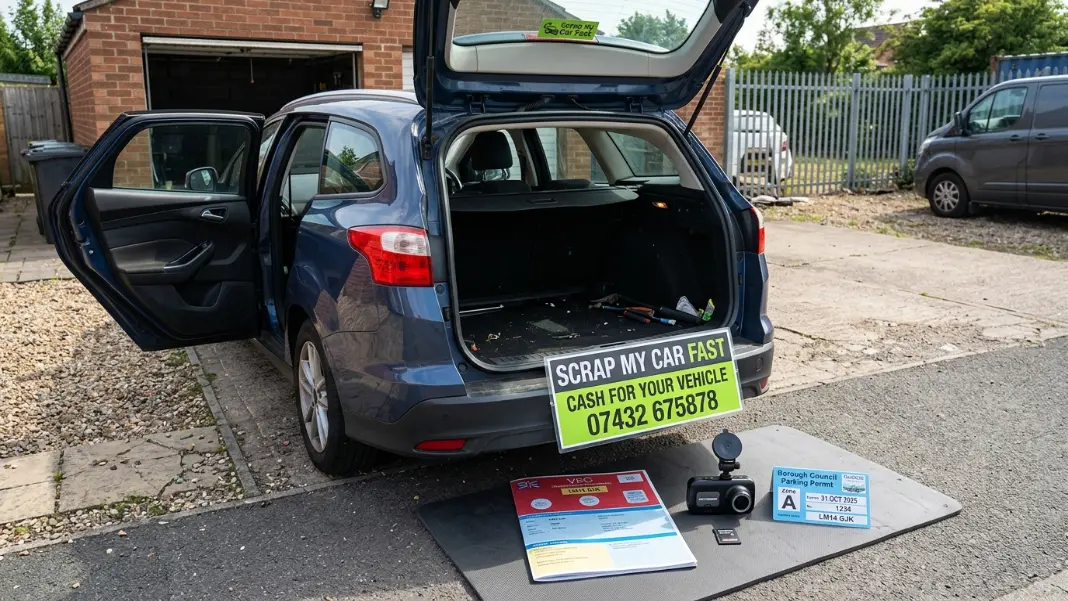
Before your car is collected, spend 20 minutes going through it properly. Most people hand over their vehicle and only realise later they left a parking badge, a dashcam worth £60, or three years of CDs in the door pocket. This checklist covers everything you genuinely need to remove, what you can safely leave, what paperwork you must sort, and which parts are worth pulling out and selling before the car goes to the Authorised Treatment Facility.
If you are ready to book, get a free scrap car quote here and we will handle the rest from there.
Documents and Legal Items: Sort These First
These are not optional. Some have legal consequences if you overlook them, and some cannot be replaced without cost and hassle.
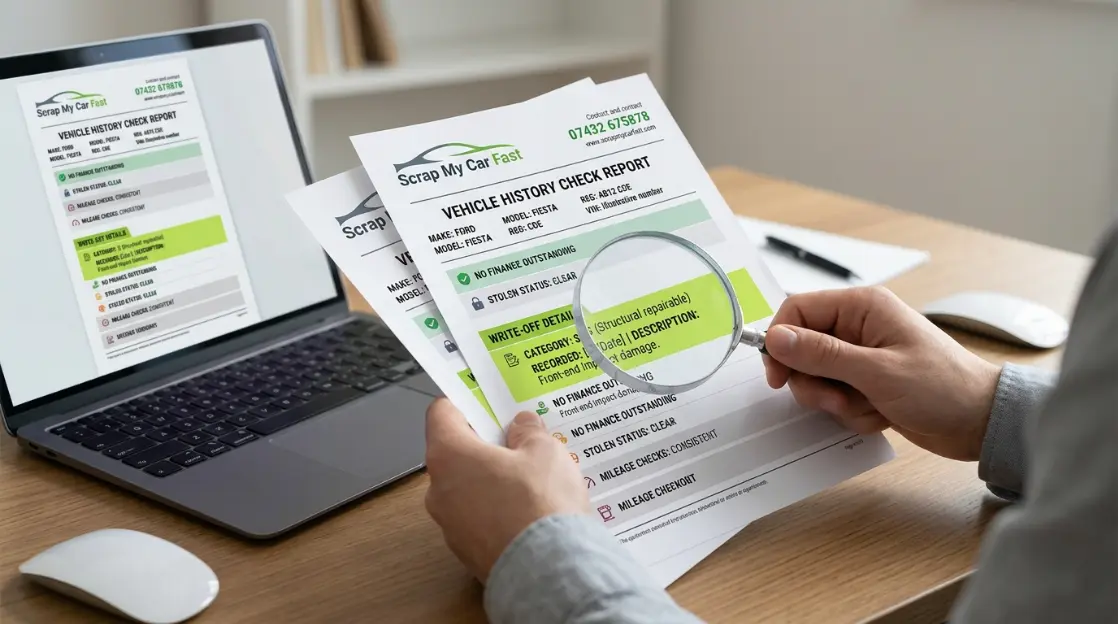
V5C logbook (vehicle registration certificate) Keep this, do not hand it over in full. Check which section applies to you: on logbooks issued after April 2019, you notify the DVLA using Section 4. On older logbooks, it is Section 9. Either way, the fastest method is the DVLA’s online scrapping notification service, which processes instantly and automatically triggers a refund on any full months of unused vehicle tax. If you go by post instead, tear off the yellow V5C/3 slip and keep it as your proof, then send only that section to DVLA, Swansea, SA99 1BD. Never hand the whole logbook to the driver on collection day. If you do not have a V5C at all, you can still scrap your car, but you will need to notify the DVLA in writing separately with the vehicle’s registration, make, model, and the ATF’s details. You are legally responsible for notifying the DVLA yourself. The ATF issuing your Certificate of Destruction does not do this for you.
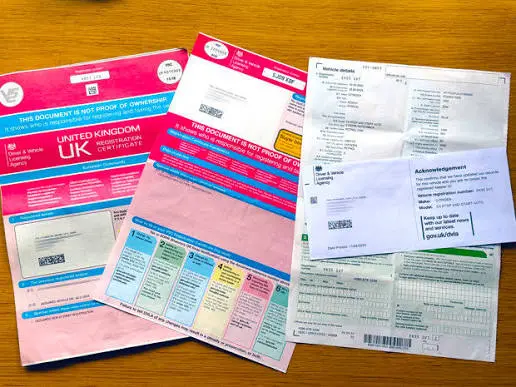
Insurance documents and MOT certificate Take these with you. The MOT certificate has no resale value but is useful if you ever need to prove the condition of the car at the time of scrapping. Cancel your insurance policy once the car is collected so you are not paying for a vehicle you no longer own.
Parking permits and resident badges Manchester City Council and Salford City Council issue parking permits tied to the vehicle. These must be returned or cancelled. If you leave them in the car and they are found, you could face difficulties when applying for a permit on your next vehicle.
DART Charge account transponder or M6 Toll tag If you drive through the Dartford Crossing or use the M6 Toll, you may have a windscreen-mounted transponder or tag. Remove it and return it to the account provider, or you will continue to be billed against a car you no longer own and the tag itself will be lost when the car is crushed.
Blue badge (disabled parking badge) Blue badges are non-transferable and must be returned to your local council when the vehicle is scrapped, sold, or when the badge expires. Do not leave one in a car being scrapped, since it stays registered to you until it is formally returned or cancelled.
Personalised or cherished number plate If your car carries a private registration you want to keep, you must retain it with the DVLA before the car is scrapped, not after. Apply online or by post using form V317 (the retention fee is currently £80), and wait for your V778 Retention Document and updated V5C logbook to arrive before booking collection. This holds the registration in your name for up to 10 years so you can put it on a future vehicle. Once a Certificate of Destruction has been issued, the plate cannot be recovered, so this step has to happen first, not as an afterthought.
Personal Belongings: Do a Full Sweep
This sounds obvious, but people consistently miss things. Do the following before collection:
- Open every door pocket and check underneath every seat. Coins, pens, sunglasses, charging cables, and children’s toys all end up jammed underneath.
- Check the boot fully. People leave spare phone chargers, shopping bags, umbrellas, jump leads, and in one case, someone’s passport in a boot pocket.
- Remove your dashcam. These are easily worth £50 to £150. They are also easy to forget because they blend into the windscreen. Unclip it, take the memory card out, and take the mount bracket too if it is worth keeping.
- Remove the sat nav. Hardwired sat navs are less common now, but if yours is a portable unit in a suction mount, take it.
- Remove child seats. These do not belong to the car. Remove them, take the instruction manual, and either keep them for your next vehicle or pass them on. Never leave a child seat to be scrapped.
- Remove roof boxes, bike racks, and tow bar accessories. These are bolted or clamped on but not part of the car itself, and most have decent resale value on their own.
Wipe Your Personal Data Before Collection
This is the step people forget most often, and it matters more with every newer car. Modern infotainment systems store paired Bluetooth devices, call logs, contact lists synced from your phone, navigation history including your home and work addresses, and in some cases saved Wi-Fi passwords or app logins. Before the car is collected:
- Go into Settings > System > Factory Reset (the exact path varies by manufacturer) and wipe the infotainment unit.
- Remove your phone from the paired Bluetooth devices list at minimum, even if you skip the full reset.
- If the car has a garage door opener built into the sun visor (HomeLink or similar), clear the paired codes.
- Check for any dash-mounted toll or fuel cards left in the glovebox, since these are tied to a live account.
None of this affects the scrap value of the car. It is entirely about protecting your own data and access.
Car Parts: What Is Worth Removing Before You Scrap?
This is where it gets more nuanced. For most people scrapping a standard car, removing parts is not worth the time. For others it is genuinely worthwhile. It depends on the car’s condition and whether you have the means to sell parts privately.
Alloy wheels If your car has alloys in good condition, they can be worth £50 to £200 depending on size and brand. The tradeoff is that you need steels to swap them onto (which you will need to source) and then list the alloys online. For a car that runs, this is practical. For a non-runner, it adds a layer of complexity, and the car still needs to be safely loaded onto a flat-bed either way. Read our full breakdown in sell your car for parts vs scrapping: which gets you more money before deciding.
Aftermarket stereo or speakers If you fitted an aftermarket head unit yourself, remove it and put the original back in, or leave a blanking plate. Aftermarket stereos in good condition sell on Facebook Marketplace quickly. Do not remove factory-fitted stereos, since they are often coded to the car and worthless out of it.
The car battery Standard lead-acid batteries have scrap value, and higher-spec or AGM/EFB batteries are worth more. If the battery is relatively new and in good condition, it may be worth removing and selling separately. A standard 60Ah battery fetches roughly £5 to £15 at a scrap metal yard, but a good condition battery sold to a private buyer can go for £30 to £60. See our guide on car battery scrap value in the UK for current prices, or check current scrap car prices generally before you decide what is worth your time.
Spare tyre If your car has a full-size spare in good condition, it is worth removing. A decent spare tyre sells for £20 to £40 locally. Space-saver spares are less useful and rarely worth the effort.
Tow bar A detachable tow bar in good condition can be worth £30 to £80 second-hand, particularly for common models. Fixed, welded-on tow bars are not worth the labour to remove.
Catalytic converter This is one of the most valuable single components on a scrap car, since it contains small amounts of platinum, palladium, and rhodium. In practice, though, we would not recommend removing it yourself. It is welded or bolted into the exhaust system, needs specialist tools to cut out safely, and under the Scrap Metal Dealers Act 2013, any scrap metal dealer buying it from you as a private individual is legally required to verify your ID and cannot pay in cash, largely because catalytic converters are a common theft target. For most people, it is simpler and safer to leave it in place. Its value is already factored into what a reputable scrap car buyer offers for the vehicle as a whole.
What You Do NOT Need to Remove
Plenty of people ask whether they should strip the car before collection. For a standard scrap, you do not need to:
- Remove standard tyres, unless you are swapping for selling alloys
- Remove seats, interior trim, or carpets
- Drain the fuel, since we handle this at the ATF
- Remove the engine or exhaust
- Remove built-in navigation systems
- Clean the car
Our collection team will take the car as-is. Everything goes to the Authorised Treatment Facility, where it is depolluted, crushed, and recycled according to Environment Agency regulations. You can see the full process in how car scrapping works, or read more on what happens to your car after it’s scrapped.
Quick Reference Checklist
| Category | Item | Action |
|---|---|---|
| Documents | V5C logbook | Complete Section 4 (post-2019) or Section 9 (pre-2019), keep yellow slip |
| Documents | Insurance & MOT certificate | Take with you, cancel insurance after collection |
| Documents | Parking permit / resident badge | Return or cancel with council |
| Documents | DART Charge / M6 Toll tag | Remove and return to provider |
| Documents | Blue badge | Return to local council |
| Documents | Personalised number plate | Retain via V317/V778 before scrapping, not after |
| Belongings | Dashcam, sat nav | Remove, take memory card |
| Belongings | Child seat | Remove, never leave in car |
| Data | Infotainment system | Factory reset, unpair Bluetooth |
| Parts (optional) | Alloys, stereo, battery, spare tyre, tow bar | Remove only if you plan to sell separately |
| Parts (leave in place) | Catalytic converter | Leave for the ATF, value is reflected in your quote |
Book Collection Across Greater Manchester
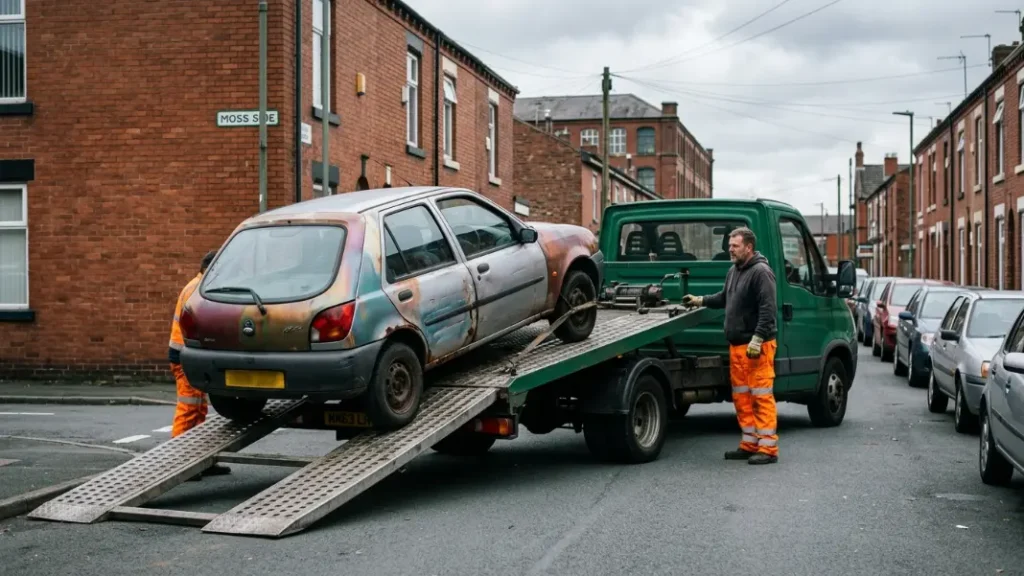
Once you have cleared the car and sorted the V5C, we can collect the same day in most cases. We cover all of Greater Manchester including Manchester city centre and surrounding areas, Salford, Bolton, Stockport, Oldham, Bury, Rochdale, Wigan, Tameside, and Trafford. Payment is by same-day bank transfer. You will receive a certificate of destruction within 7 days confirming the vehicle has been legally scrapped.
Get your free quote now and we will confirm a time that works for you.
Frequently Asked Questions
Do I need to remove the number plates before scrapping?
No. Number plates stay on the vehicle when it is collected. The DVLA deregisters the vehicle once you notify them, and the plates are destroyed at the ATF. You only need to remove plates if you are transferring a personalised registration to a new vehicle, which must be done via the DVLA website before collection.
What happens to personal data saved in the car’s infotainment system?
Modern cars store Bluetooth-paired devices, navigation history, and sometimes saved passwords from connected apps. Before collection, go into the car’s settings and perform a factory reset. The exact process varies by make and model but is usually under Settings > System > Factory Reset or similar. Remove your phone from the Bluetooth paired devices list at minimum.
Do I need to remove the car battery?
Not unless you want to sell it separately. If you are not planning to sell the battery privately, leave it in the car. The ATF removes and recycles batteries as part of the standard depollution process. Removing it yourself and leaving an empty battery tray does not affect the scrap value.
Can I remove parts to sell them separately before I book collection?
Yes, as long as the car can still be safely loaded onto a flat-bed truck. If you remove wheels and leave the car sitting on brake discs, or remove the bonnet and leave the engine exposed, collection becomes more complicated. Talk to us before making major modifications. For a car that drives or rolls freely, removing small parts is not an issue.
Can I keep my personalised number plate when I scrap my car?
Yes, but you must retain it with the DVLA before the car is scrapped. Apply using form V317 (online or by post, currently £80), and wait for your V778 Retention Document and a new V5C to arrive before booking collection. Once a Certificate of Destruction has been issued the plate cannot be recovered, so this needs to happen first.
Should I remove the catalytic converter before scrapping?
We would not recommend it. It is one of the most valuable parts on the car due to the precious metals inside, but it is welded into the exhaust, needs specialist cutting tools, and private sales of loose catalytic converters are tightly regulated under the Scrap Metal Dealers Act 2013 because of theft concerns. It is simpler to leave it in place. Its value is already reflected in a fair scrap quote for the whole vehicle.
Which section of the V5C do I fill in to notify DVLA of scrapping?
It depends on when your logbook was issued. Logbooks issued after April 2019 use Section 4. Older logbooks use Section 9, labelled “selling or transferring your vehicle to a motor trader, insurer or dismantler.” Either way, tear off the yellow V5C/3 slip and keep it as your proof, and send the corresponding section to DVLA at Swansea, SA99 1BD, or use the DVLA’s online service for faster processing. See our full guide on notifying the DVLA when you scrap your car.
Do I need to notify the DVLA before or after the car is collected?
You notify the DVLA when you hand over the vehicle, using the yellow slip from your V5C or the online service, and keep proof either way. We issue a certificate of destruction within 7 days, which you should also keep. The DVLA will refund any remaining full months of vehicle tax automatically. For more answers to common questions, visit our FAQs page.