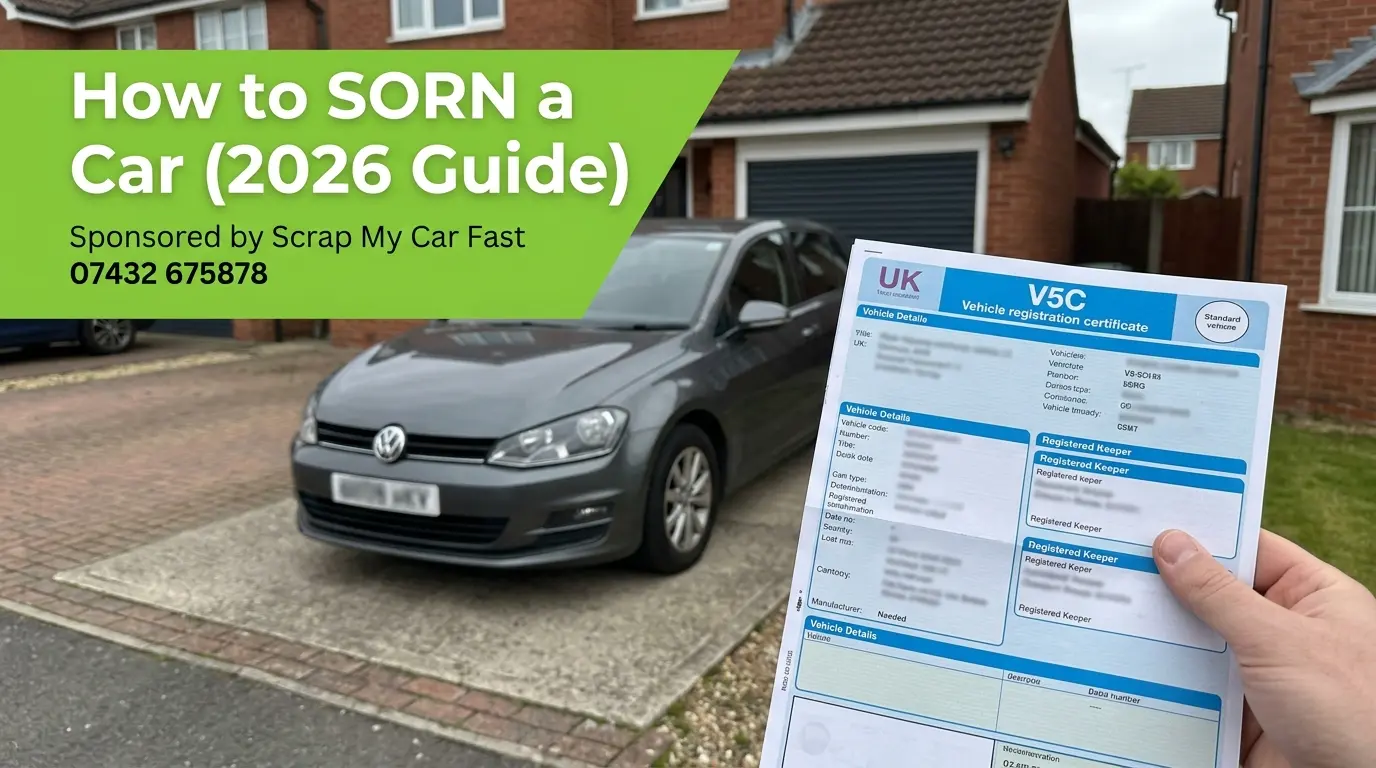
To SORN a car, go to the DVLA’s Make a SORN page and enter your registration number and the 11-digit reference from your V5C logbook. You can use the 16-digit number from a tax reminder letter (V11) instead. Confirm the details and you’re done. It’s free, it takes a couple of minutes, and it’s confirmed straight away. From then on the car doesn’t need tax, but it must stay on private land, such as a drive or garage, and never on the road.
Any full months of tax you’ve already paid are refunded automatically. The SORN lasts until you tax, sell, scrap or export the car.
We collect a lot of cars across Greater Manchester that have been sitting SORN on drives for months, sometimes years. The same handful of questions come up every time: where the car can be kept, whether it needs insurance, what the refund covers, and how to undo it. This guide answers all of them, using the DVLA’s own rules as of September 2026.
Quick facts
- What SORN means: Statutory Off Road Notification. You’re telling the DVLA the car is off the road, so it doesn’t need to be taxed.
- Cost: free.
- How: online at gov.uk, by phone on 0300 123 4321, or by post with form V890.
- You need: the 11-digit V5C reference or the 16-digit V11 reference.
- Where the car can be: a drive, garage or other private land. Not the street, the pavement or a public car park.
- How long it lasts: it doesn’t expire. It ends when you tax, sell, scrap or export the car.
- Tax refund: automatic, for any full months left.
What does SORN mean?
SORN stands for Statutory Off Road Notification. By law, every vehicle registered with the DVLA has to be either taxed or declared off the road. There’s no third option where you just let the tax run out and leave it on the drive.
A SORN is that declaration. It tells the DVLA you’re not using or keeping the car on a public road, so you don’t need to pay vehicle tax on it.
A SORN doesn’t need renewing. Once it’s made, it stays in place until one of four things happens: you tax the car again, you sell it, you scrap it, or you export it permanently. It also stays with you, not the car. When a car is sold, the SORN doesn’t pass to the new keeper.
When should you SORN a car?
You need a SORN any time a car is going to sit untaxed. The most common reasons we come across are:
- It’s failed its MOT and you haven’t decided whether to repair it or let it go.
- It needs repairs you can’t afford right now, so it’ll be parked up for a while.
- It’s a project car or a second car you only use in summer.
- You’re going abroad for months and the car is staying at home.
- You want to break it for parts before you scrap it.
- You’re waiting for a scrap collection that isn’t happening in the next few days, and the tax has run out.
When you don’t need a SORN
- You’ve sold the car. Tell the DVLA about the sale instead. If a tax reminder turns up afterwards, you can ignore it.
- You’re scrapping it soon. When a licensed scrap facility takes the car, it notifies the DVLA and issues a Certificate of Destruction. That closes the record and triggers any tax refund, so there’s nothing to SORN. See how DVLA notification works when you scrap a car.
- The car is still taxed and you’re keeping it insured. There’s no need to SORN a taxed car. You’d only lose the tax.
How to SORN a car online
This is the quickest route, and you get confirmation straight away.
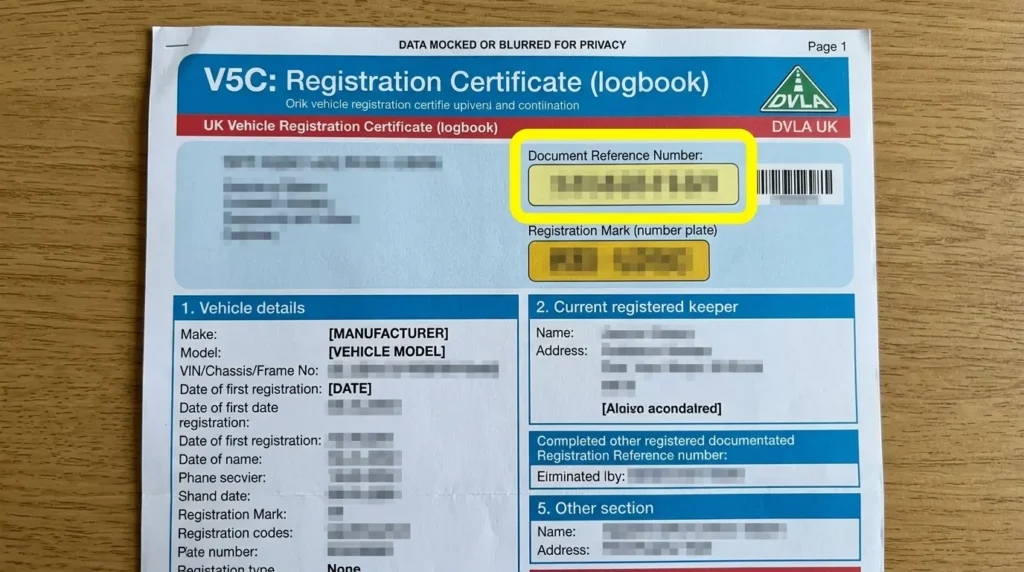
- Find your reference number. Use either the 11-digit document reference number on your V5C logbook or the 16-digit number from a V11 tax reminder letter. On the current V5C, the 11-digit number is printed on the front page.
- Check your V5C details are correct. If the name or address is wrong, fix that first. The DVLA sends any refund to the name and address on the logbook.
- Go to gov.uk/make-a-sorn and enter the registration number and your reference number.
- Confirm the vehicle and submit. You’ll see the make and colour so you can check it’s the right car.
- Save the confirmation. You’ll get an email. Keep it until the car is taxed, sold or scrapped.
Other ways to SORN a car
- By phone: call the DVLA vehicle tax line on 0300 123 4321. You’ll need the same reference number.
- By post: fill in form V890 and send it to the DVLA. It’s slower, so if the car is already untaxed, use the online or phone route.
- If you don’t have a V5C: you can’t do it online without a reference number. SORN by post using the V890 instead, and apply for a replacement logbook with form V62. Our lost V5C guide covers the replacement.
- If you’ve just bought the car: the previous owner’s SORN doesn’t carry over. You need to make your own before the car sits untaxed. If you only have the new keeper slip and the car isn’t in your name yet, the postal route is usually the one that works.
When does a SORN start?
In most cases a SORN starts on the day you make it. The exception is using a V11 tax reminder in the month your tax runs out, which can set it to start on the first day of the next month.
You can’t backdate a SORN. If your tax ended last month and you only declare today, the gap in between still counts as untaxed. That’s what triggers the automatic fines further down.
SORN rules: what you can and can’t do
This is where most people slip up. The rules are simple once you see them side by side.
| Situation | Allowed with a SORN? |
|---|---|
| Keeping the car on your drive, in a garage or on private land | Yes |
| Parking it on the street outside your house | No |
| Parking it on a pavement or in a public car park | No |
| Driving it to a pre-booked MOT test (insured) | Yes |
| Driving it anywhere else, even round the block | No |
| Having it collected on a recovery truck or trailer | Yes, because it isn’t being driven on the road |
| Working on it or stripping it at home | Yes, on private land |
| Cancelling the insurance | Yes, it isn’t legally required, but you may want fire and theft cover |
| Selling it | Yes. The buyer has to tax it or make their own SORN |
The street rule catches a lot of people out. “Off road” means genuinely off the public road. The kerb outside your house doesn’t count, even if the car hasn’t moved in months. Enforcement officers can see a SORN car on the road and act on it.
How the SORN tax refund works
When a SORN goes through, the DVLA cancels your vehicle tax. Any full calendar months left are refunded automatically, and you don’t have to apply. If you pay by Direct Debit, that’s cancelled too. The refund goes to the name and address on the V5C, which is why those details need to be right.
Part months aren’t refunded. So timing matters.
Example: your tax is paid up to the end of March. You make the SORN on 10 November. November is a part month, so you get it back for December, January, February and March, which is four full months. If you’d waited until 2 December, you’d lose December as well.
If you’re about to take a car off the road anyway, making the SORN before the first of the month can save you a month’s tax.
SORN fines: what happens if you get it wrong
The DVLA publishes its enforcement policy for vehicle tax offences, last updated in January 2026. The main penalties are:
| What went wrong | What the DVLA does |
|---|---|
| The car is untaxed and not SORN, even if it’s just sitting on your drive | An automatic £80 late licensing penalty, reduced to £40 if paid within 33 days. Unpaid penalties go to a debt collection agency |
| An untaxed car is seen on a public road without a SORN | An out of court settlement of £30 plus one and a half times the tax owed. If it goes to court, £1,000 or five times the tax, whichever is higher. The car can be clamped |
| A car is seen on a public road with a SORN in force | An out of court settlement of £30 plus twice the tax owed. If it goes to court, £2,500 or five times the tax, whichever is higher. The car can be clamped |
The fine is higher when a SORN is in place. Once you’ve told the DVLA the car is off the road, using it on the road is treated more seriously.
Insurance is a separate check. A car that isn’t SORN has to be insured, even if it never moves. Letting the insurance lapse on a car without a SORN can bring its own penalty on top of the tax one.
How to check if a car is SORN
Use the free vehicle tax check on gov.uk. Enter the registration and it shows whether the car is taxed, untaxed or declared SORN. It’s worth doing before you buy a used car, and it’s a quick way to confirm your own SORN went through.
A long SORN usually leaves a gap in the car’s MOT history, because a car kept off the road isn’t being tested. If you’re buying one, ask why it was off the road and check the MOT history for the last recorded mileage.
How to unSORN a car
There’s no separate “cancel SORN” form. You unSORN a car by taxing it, and the SORN ends automatically the moment the tax starts.
To tax it, the car needs:
- A valid MOT, unless it’s exempt. If the MOT has run out while it was SORN, book a test first. You can legally drive it to a pre-booked MOT as long as it’s insured for that journey. Our guide on driving without an MOT explains the limits.
- Insurance in place from the day it goes back on the road.
- Your V5C reference, V11 reference, or new keeper slip.
Tax it online at gov.uk, and you can drive it straight away.
SORN and scrapping your car
If a car is coming off the road for good, you don’t always need a SORN.
- Collection in the next few days: skip the SORN. The Certificate of Destruction tells the DVLA the car has gone, and any full months of tax are refunded automatically.
- Waiting a while, and the tax has run out: make a SORN now. That avoids the automatic £80 penalty while it sits on the drive.
- Already SORN: you don’t need to cancel it before scrapping. The scrap notification closes the record. Our guide to selling or scrapping a car without MOT or tax covers this in more detail.
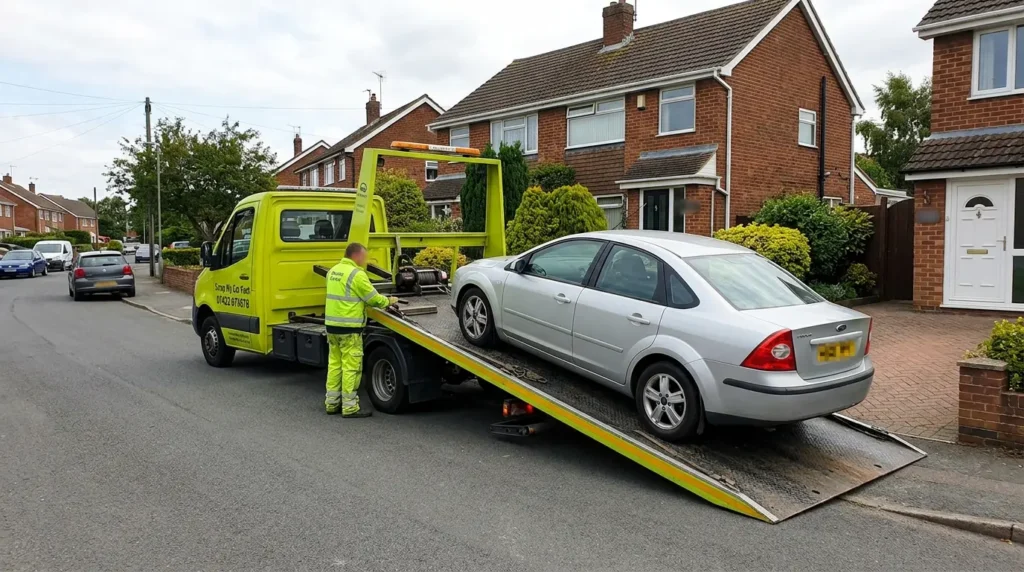
One practical point: don’t move a SORN car onto the street so it’s easier to collect. That’s the one thing a SORN doesn’t allow. We load cars from drives, garages and private land all the time, including cars that won’t start, so leave it where it is.
Frequently asked questions
Does it cost anything to SORN a car?
No. Making a SORN is free, whether you do it online, by phone or by post. Be wary of any website that asks for a fee to do it for you.
How long does a SORN last?
It doesn’t expire and there’s nothing to renew. A SORN stays in place until you tax, sell, scrap or permanently export the vehicle.
Do I need insurance on a SORN car?
Not legally. Once a car is declared SORN, the requirement to insure it no longer applies. Many owners keep fire and theft cover anyway, especially for a car stored for a long time. If you drive it to a pre-booked MOT, it must be insured for that journey.
Can I drive a SORN car?
Only to a pre-booked MOT test, and it must be insured for that journey. Driving it anywhere else is an offence, and the penalty is higher than for an untaxed car without a SORN.
Can I park a SORN car on the road outside my house?
No. A SORN car must be kept on private land, such as a drive, garage or private car park. The public road, the pavement and public car parks all count as “on the road”.
Can I SORN a car without the V5C logbook?
Not online, because you need a reference number. If you have a V11 tax reminder, you can use its 16-digit number instead. Otherwise, SORN by post with form V890 and apply for a replacement logbook with form V62.
Does a SORN transfer to the new owner?
No. A SORN ends when the car is sold. The new keeper has to tax the car or make their own SORN before they keep it untaxed.
Do I need to SORN my car before scrapping it?
Not if it’s being collected soon. The scrap facility notifies the DVLA and any full months of tax are refunded automatically. If the car will sit untaxed for a while first, make a SORN to avoid a penalty in the meantime.
Got a SORN car you’re ready to get rid of?
If a car has been sitting SORN on your drive and you’ve decided it isn’t going back on the road, we’ll take it from exactly where it is. Get an instant scrap car quote, and we’ll collect it for free from anywhere in Manchester, Salford, Stockport, Oldham, Bury and the rest of Greater Manchester. There’s no need to tax it, insure it or get it running first. Payment goes to your bank account on the day, and we handle the DVLA paperwork and Certificate of Destruction. You can also call us on 07432 675878.
This guide reflects DVLA rules for England, Scotland and Wales as of September 2026. It’s general guidance, not legal advice.