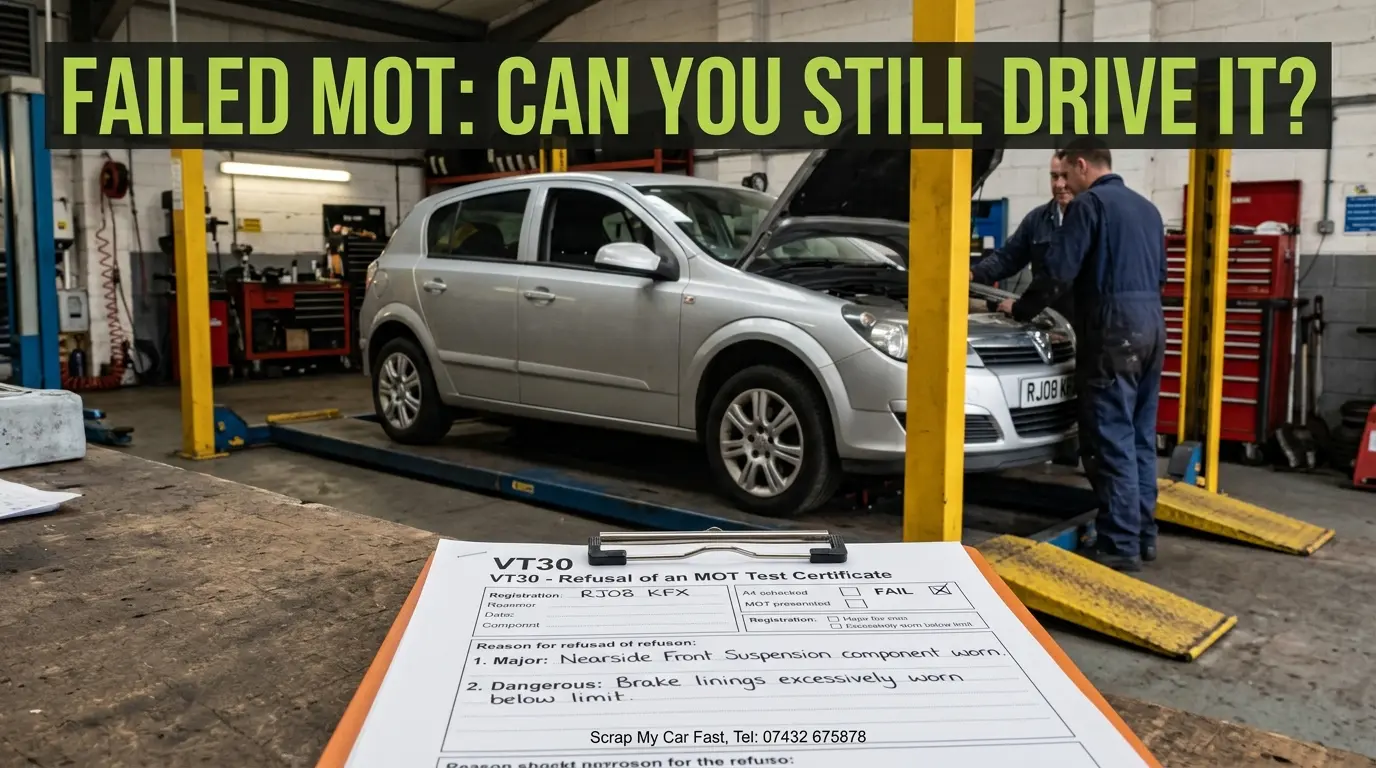
Can you drive a car that failed its MOT? Sometimes, but only in two situations. The first is when your old MOT certificate hasn’t run out yet and the tester found no “dangerous” faults. The second is when you’re driving straight to a garage for repairs or to a pre-booked MOT test. If the car failed with a dangerous defect, you can’t drive it at all, not even home. Get it wrong and you face a fine of up to £1,000, or up to £2,500 plus three penalty points and a possible ban if the car is dangerous.
A lot of guides get this wrong. Some tell you a failed car can never be driven, and others make it sound as if a booked retest covers any journey. Neither is right. The honest answer depends on three things: whether your old certificate is still valid, what category of fault was found, and where you’re going.
We collect MOT failures across Greater Manchester every week, often straight from the test centre. So this is the practical version, based on the current DVSA rules as of September 2026.
Quick answer
- Old MOT still valid and no dangerous faults: you can drive it until the old certificate runs out, as long as it’s roadworthy.
- Old MOT expired and major faults only: only to a garage for the repairs or to a pre-booked MOT test.
- Any “dangerous” fault: don’t drive it. Repair it at the test centre or have it recovered.
- No valid MOT and no test or repair booked: you can’t drive it, and you can’t leave it parked on the road either.
- Fines: up to £1,000 for no MOT. Up to £2,500, 3 points and a possible ban for a dangerous vehicle.
Can I drive my car if it fails its MOT?
It comes down to which of these situations you’re in. Find yours in the table.
| Your situation | Can you drive it? | Where to |
|---|---|---|
| Failed with major faults, old certificate still valid | Yes, if the car is roadworthy | Anywhere, until the old certificate expires |
| Failed with major faults, old certificate expired | Only for specific journeys | Direct to a garage for the failed items, or to a pre-booked MOT test |
| Failed with a dangerous fault, whatever the old certificate says | No | Nowhere. Repair it on site or arrange recovery |
| MOT expired, car not tested yet | Only for specific journeys | Direct to a pre-booked MOT test, or to a garage for repairs |
| Passed with minor faults or advisories | Yes | Anywhere, but get the minor faults sorted soon |
| You want to take it to a scrapyard and it has no valid MOT | No | Neither exception covers this journey. Book a collection instead |
Why the old certificate matters
Many people put their car in for its MOT a week or two early. You can have it tested up to one month (minus a day) before the expiry date and keep the same renewal date. If it fails during that window, your old certificate is still in force until its original expiry date.
In that case you can drive the car away and get it fixed wherever you like, as long as none of the faults were listed as dangerous. The catch is that the car must still meet basic roadworthiness standards the whole time. A valid certificate doesn’t protect you if the car has bald tyres or brakes that don’t work. The police can still prosecute for the condition of the car itself.
Minor, major and dangerous: what the categories mean
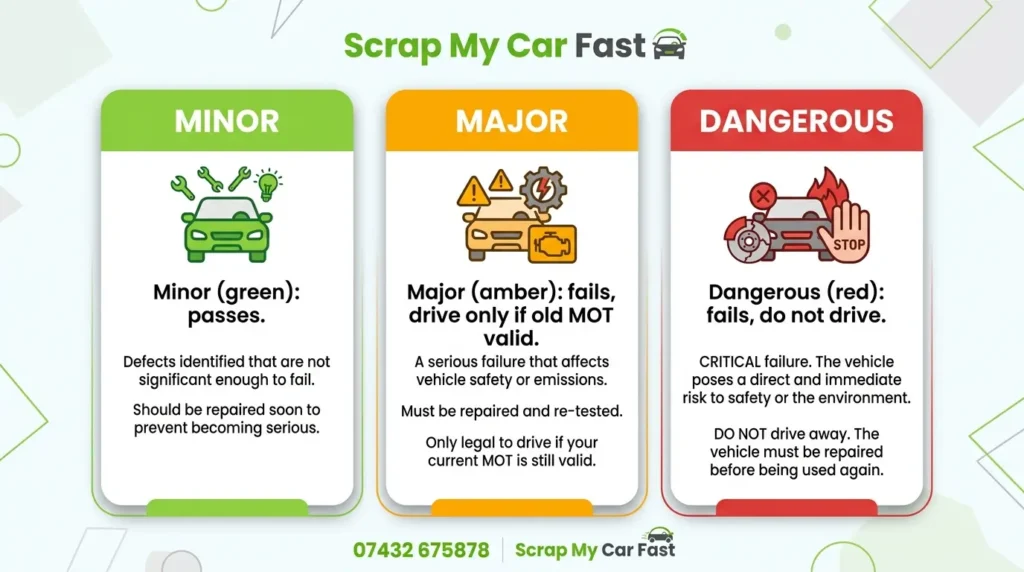
Since 2018, every fault on an MOT is given one of three labels, and the label decides what happens next.
- Minor: the car passes. The fault is recorded, and you should fix it soon.
- Major: the car fails. It needs repairing before it can pass. Whether you can drive it depends on your old certificate, as the table above shows.
- Dangerous: the car fails, and the tester is saying it’s a direct risk to road safety. You can’t drive it away, even with an old certificate still valid.
Your failure sheet is called a VT30, or “refusal of an MOT test certificate”. It lists every fault and its category. Keep it, because you’ll need it for the retest and any appeal.
Driving without an MOT: the fines and other risks
If your MOT has expired, the law is strict. There’s no grace period. The certificate stops being valid at the end of the expiry date. After that, the only legal journeys are to a pre-arranged MOT test or to and from a place of repair.
It also catches out more people than you’d think. DVSA figures show that over 20% of all MOT tests carried out between 2023 and 2025 were on vehicles whose MOT had already expired. That’s more than 8.3 million cars in 2025 alone.
| Offence | Maximum penalty |
|---|---|
| Driving without a valid MOT | Fine of up to £1,000 |
| Driving a car that failed with a dangerous fault | Fine of up to £2,500, 3 penalty points, possible driving ban |
| Driving an unroadworthy car, even with a valid MOT (for example, illegal tyres) | Fines and points per offence. Each illegal tyre can bring up to £2,500 and 3 points |
The fines aren’t the only cost:
- Cameras will spot it. Police automatic number plate recognition (ANPR) cameras and patrol cars check MOT status in real time. A car with no valid MOT is flagged almost instantly.
- Your insurance may not pay out. Many insurers treat a car with no valid MOT, or one that has failed on dangerous faults, as unroadworthy. That can give them grounds to reduce or refuse a claim, which could leave you personally paying for damage or injury. Check your policy wording.
- You can’t renew your road tax. The DVLA won’t let you tax a car without a valid MOT. Tax you’ve already paid doesn’t get cancelled, but when it’s due you’re stuck until the car passes.
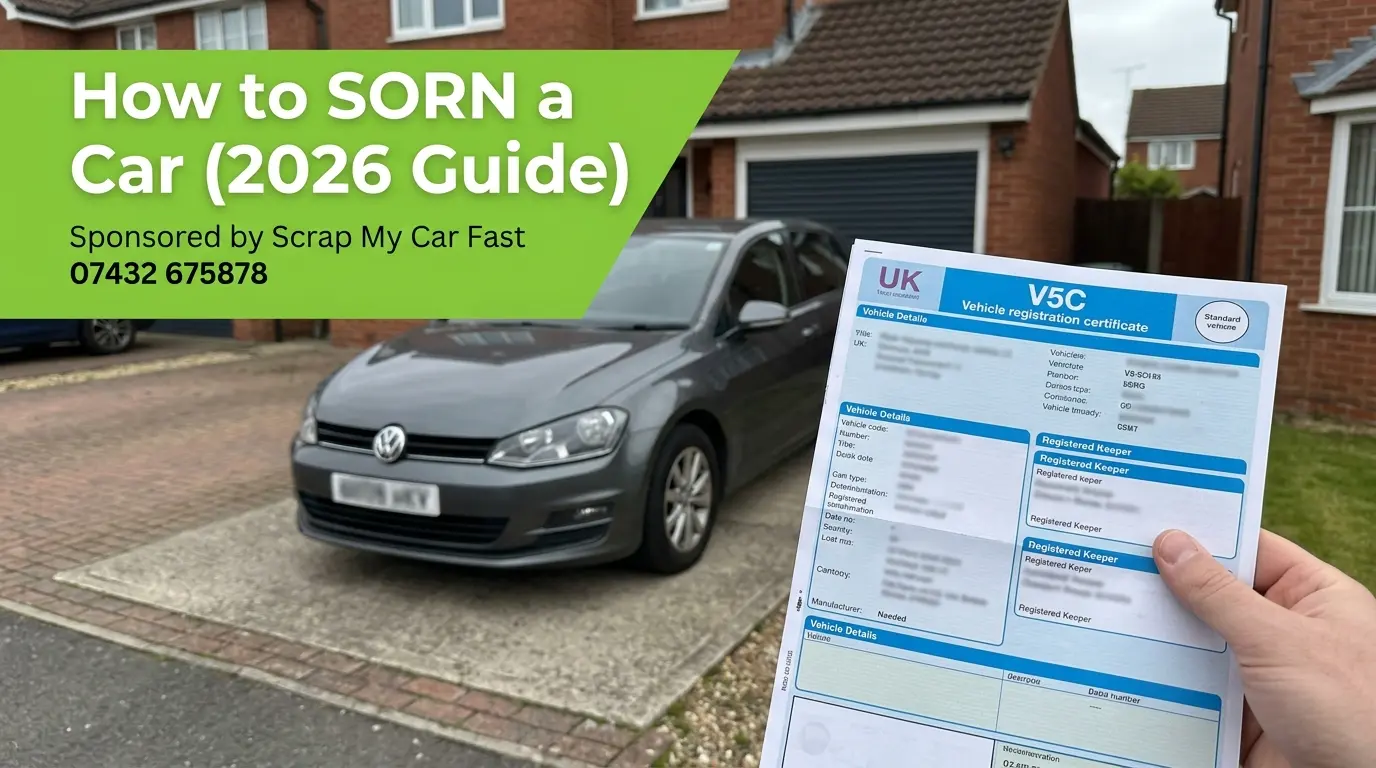
- It can’t stay parked on the street. A car with no MOT can’t be kept on a public road. If it’s going to sit for a while, it needs to be off the road, on a drive or in a garage, and declared SORN.
What counts as a “pre-booked” test or repair?
This is where people get caught out. The exemption only covers a direct journey to an appointment that already exists. Driving around with a “we’ll book it next week” plan doesn’t count, and neither does stopping at the shops on the way.
Keep the booking confirmation on your phone in case you’re stopped. The car also has to be taxed, insured and safe for that trip. The exemption only covers the missing certificate, nothing else.
Your retest options after a failed MOT
If you’re going to repair the car, the timing of the retest makes a real difference to the cost. These are the current gov.uk retest rules:
| What you do | Retest type | Cost |
|---|---|---|
| Leave the car at the test centre for repair, retested within 10 working days | Partial retest | Free |
| Take it away and bring it back by the end of the next working day (only for certain listed faults) | Partial retest | Free |
| Take it away, repair it elsewhere, bring it back to the same centre within 10 working days | Partial retest | Reduced fee, often around half |
| Go to a different test centre, or return after 10 working days | Full MOT | Full fee, up to £54.85 for a car |
Working days means Monday to Friday, not counting bank holidays. So a fail on a Thursday gives you until the Thursday two weeks later, not the following Sunday.
Think the fail was wrong?
You can appeal to the DVSA using form VT17 within 14 working days of the test. The important rule is don’t repair anything before you appeal. Once the car has been touched, the examiner can’t judge whether the original fail was fair.
When a failed MOT means it’s time to scrap the car
Sometimes the fail sheet tells you more than which parts need replacing. It tells you the car has reached the end of its economic life. A £1,400 repair bill on a car worth £900 is a common story, especially with older diesels, rusted subframes, or a missing or failed catalytic converter.
A simple rule of thumb: if fixing the failures (plus any serious advisories that will fail next year) would cost more than about half of what the car is worth afterwards, think hard before paying for it. We work through the full repair, sell or scrap decision, with typical costs for each failure item, in our guide to what to do after a failed MOT.
If you do decide to let it go, two things are worth knowing:
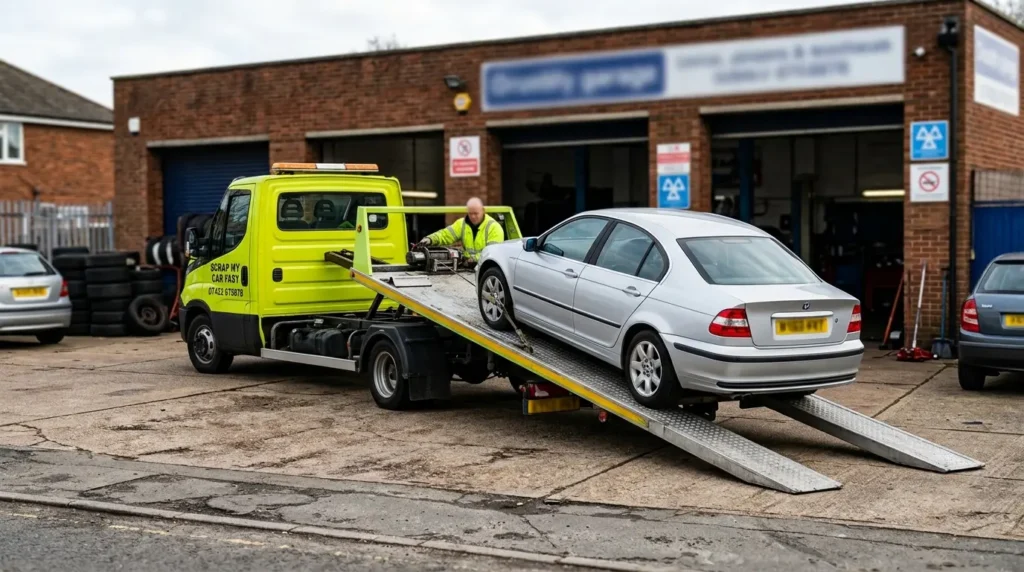
- Don’t drive it to a scrapyard. With no valid MOT, that journey isn’t allowed. Neither is a car with dangerous faults, whatever the certificate says. You don’t need to move it anyway. We collect for free from your drive, a car park on private land, or the test centre itself. Just check first that the garage will release the car to our driver. Same-day slots are often available. See same-day scrap car collection.
- The MOT result doesn’t change what the car is worth as scrap. Scrap value comes from weight and metal content, not roadworthiness. A car with a stack of MOT failures is worth the same as an identical one with a fresh certificate. The exception is missing parts, especially the catalytic converter.
If you’d rather sell the car privately, that’s legal as long as you’re upfront about the MOT. Our guide to selling a car without an MOT covers what buyers and the DVLA need from you.
What to do after a failed MOT: step by step
- Read the VT30 carefully. Check which faults are major and which are dangerous, and whether your old certificate is still valid. You can check your MOT expiry and full test history for free on gov.uk.
- Decide whether the car can legally move. Use the table at the top of this guide. If there’s a dangerous fault, don’t drive it.
- Get a full repair quote. Include the failure items and any advisories likely to fail next time.
- Compare the repair cost with the car’s value after repair. Look at similar cars on sale with a full MOT.
- Pick your route and act inside the 10 working day window. Either repair it for a free or cheaper retest, or scrap it or sell it. If it’s going to sit, keep it off the road and declare SORN.
Frequently asked questions
Can I drive my car home after it fails its MOT?
Only if your old MOT certificate is still valid and no dangerous faults were found. If the old certificate has expired, you can only drive it straight to a garage for repairs or to a pre-booked MOT. With a dangerous fault, you can’t drive it home at all.
What is the fine for driving without an MOT?
Up to £1,000. If the car has failed its MOT with a dangerous fault, the penalty rises to a fine of up to £2,500, three penalty points and a possible driving ban.
Is there a grace period after my MOT expires?
No. Your MOT stops being valid at the end of the expiry date. From then on, you can only drive the car to a pre-arranged MOT test or to a garage for repairs.
Can I drive to an MOT if my MOT has expired?
Yes, as long as the test is already booked and you drive straight there. The car must still be taxed, insured and roadworthy. Keep your booking confirmation handy in case you’re stopped.
Does a failed MOT make my car insurance invalid?
A failed MOT doesn’t cancel your policy by itself. But driving with no valid MOT, or with dangerous faults, can give your insurer grounds to reduce or refuse a claim. Check your policy wording, and avoid driving the car until it’s legal.
How long do I have to get a free MOT retest?
If the car stays at the test centre for repairs, the partial retest is free within 10 working days. If you take it away, it’s free for certain listed faults when you bring it back by the end of the next working day. After that, you’ll pay a reduced partial fee, or the full fee after 10 working days.
Can I scrap a car that has failed its MOT?
Yes. MOT status has no effect on whether a car can be scrapped or on its scrap value. Because the car usually can’t be driven legally, book a free collection rather than driving it to a yard.
Can I park my car on the street without an MOT?
No. Government guidance says you can’t drive or park a car on the road once its MOT has run out. Keep it on private land, such as a drive or garage, and declare SORN if it won’t be taxed.
Failed MOT in Greater Manchester? We’ll collect it
If the repair bill doesn’t add up, you don’t need to risk driving the car anywhere. Get an instant quote for your MOT failure car. We’ll collect it for free from your home or the test centre anywhere in Manchester, Salford, Stockport, Bolton, Wigan and the rest of Greater Manchester. Payment goes to your bank account on the day of collection, and we handle the DVLA paperwork and Certificate of Destruction. Prefer to talk it through? Call us on 07432 675878.
This guide reflects DVSA and gov.uk rules for England, Scotland and Wales as of September 2026. It’s general guidance, not legal advice.