If your car has failed its MOT, you have four choices: repair it, sell it as a non-runner, trade it in, or scrap it. For most vehicles where the repair bill exceeds the car’s market value, scrapping is the financially sound decision. This guide gives you the framework to work that out using real numbers rather than guesswork.
Your Four Options After an MOT Failure
An MOT failure is not the end of the road, but it does force a decision. The right option depends on the repair cost, the car’s age and market value, whether you need to keep driving it, and how quickly you want the situation resolved.
Option 1: Repair It and Pass the Retest
If the failure items are straightforward, repairing the car is the most obvious route. Return to the same testing station within 10 working days and you pay a reduced retest fee covering only the items that failed. Use a different garage and you pay the full MOT fee again.
Repair makes financial sense when the cost of fixing the failure items is substantially lower than the car’s current market value and you intend to keep using or selling it. It also makes sense when the car is relatively recent or has low mileage, where a current MOT significantly increases what a private buyer will pay.
Option 2: Sell It Privately as a Non-Runner
You can legally sell a car that has failed its MOT, but you must disclose the failure to the buyer. The market for failed MOT cars includes mechanics, enthusiasts and traders who intend to fix and resell. Prices vary widely and the pool of buyers is small. Many failed MOT cars sit on private sale platforms for weeks or months, eventually selling for close to their scrap value after the seller has spent time, money and effort on advertising and viewings.
Option 3: Part Exchange at a Dealership
Most franchised dealers will not accept a failed MOT car as part exchange unless they plan to scrap it themselves. Those who do accept it will price accordingly: the valuation reflects their cost of disposing of it, which is typically close to scrap value with their margin added. Part exchange on a failed MOT car rarely returns meaningful money.
Option 4: Scrap It
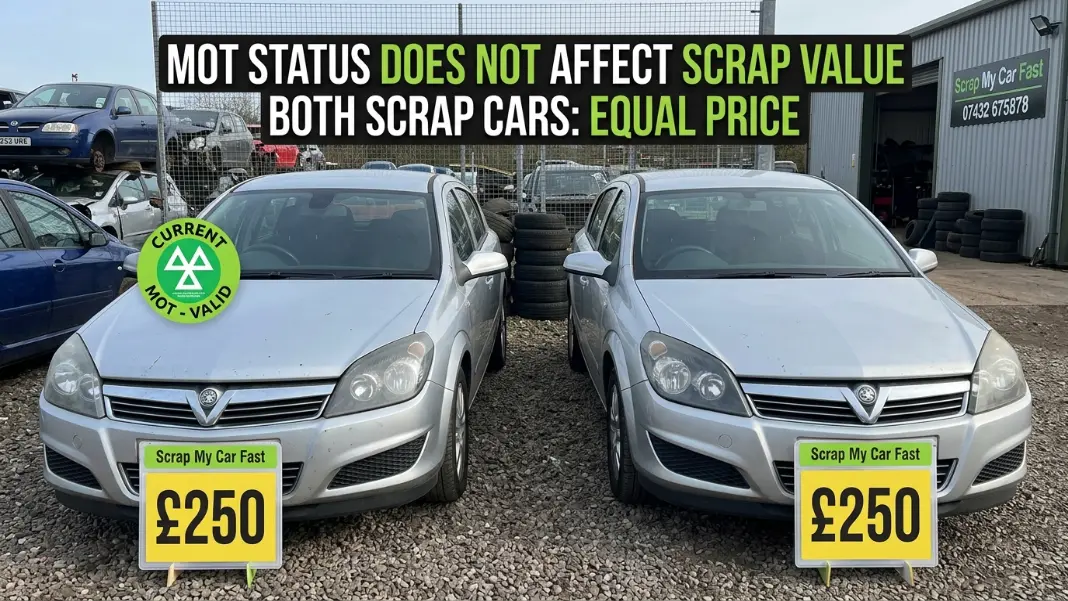
Scrapping delivers a guaranteed price based on your vehicle’s weight and the current scrap metal rate. This price is completely independent of MOT status. A car that needs £1,500 in repairs to pass its MOT is worth the same to a scrap dealer as one with a fresh 12-month certificate of the same make, model and year.
This is the key point that most people miss: MOT status has no effect on scrap value. The scrap price reflects the weight of metal in the vehicle, not its roadworthiness.
The Repair Cost vs Scrap Value Calculation
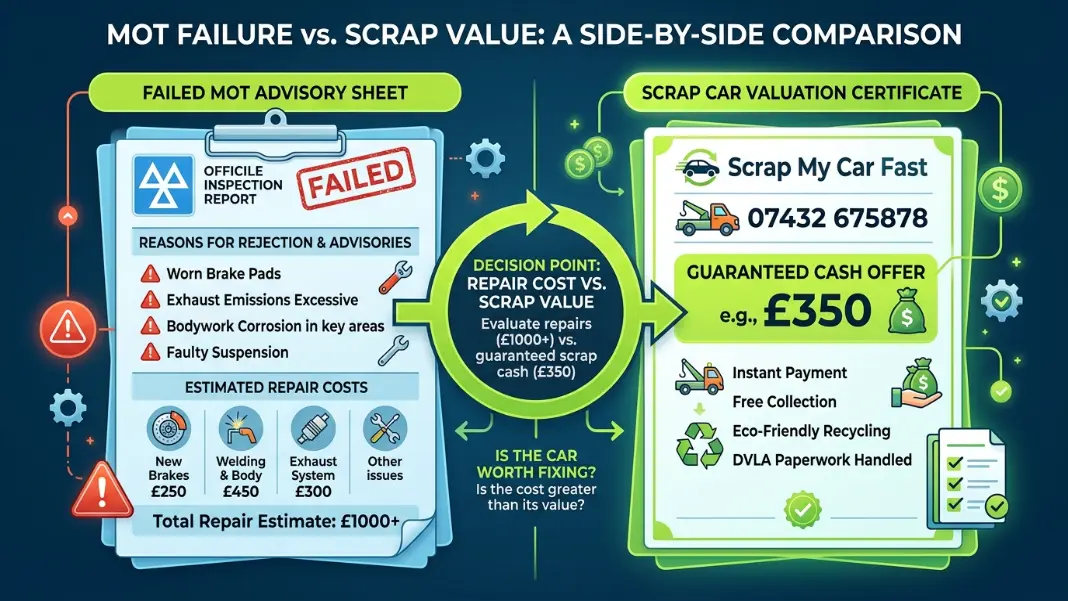
The decision comes down to three numbers: the cost of repair, the market value of the car after repair, and the scrap value. Here is how to work through it systematically.
Step 1: Get the Scrap Value
Enter your registration on any licensed scrap buyer’s website. The price is based on the vehicle’s kerb weight as held by DVLA records, multiplied by the current scrap steel rate, adjusted for the presence of the catalytic converter and the completeness of the vehicle. For most common passenger cars across Greater Manchester, this currently falls between £150 and £450. Heavier vehicles and those with intact catalytic converters attract more.
Step 2: Get the Full Repair Quote
Ask the testing garage for a complete itemised list covering both the failure items and any advisory notices. Advisories are not failures today, but they may fail the next MOT. If advisories are likely to become failures within 12 months, factor their cost into your calculation. Fixing only the failure items and ignoring serious advisories means paying for a retest that may not survive long.
Step 3: Find the Post-Repair Market Value
Check what cars of the same make, model, year and mileage are selling for with a current MOT. Use Auto Trader, Motors.co.uk or similar platforms to find comparable listings and set a realistic private sale price. This is the best-case amount you would receive after spending the repair money.
Step 4: Apply the Decision Framework
| Situation | Recommended Action |
|---|---|
| Repair cost is less than 50% of post-repair market value | Fix it — the investment makes sense |
| Repair cost is 50% to 80% of post-repair market value | Borderline — consider whether you actually want to keep this car |
| Repair cost exceeds post-repair market value | Scrap it — spending more than the car is worth is not rational |
| Repair cost is less than market value but more than scrap value | Fix it if you want to keep it, scrap it if you want to move on |
Most people find themselves in the third row. A 2012 Vauxhall Astra worth £1,200 on the private market needing £1,600 in repairs is a very common situation. Spending £1,600 to recover £1,200 makes no financial sense. Scrapping it for £280 and putting that toward a replacement car does.
Common MOT Failure Items and Whether They Tip the Balance Toward Scrapping
Some failure items are cheap to fix in isolation. Others are expensive enough that on an older or lower-value car, they signal that the vehicle has passed the point of economical repair. Here is a guide to common failures and their typical costs:
| Failure Item | Typical Repair Cost | When to Consider Scrapping |
|---|---|---|
| Tyres (one or two) | £80 – £200 | Rarely by itself — only combined with other issues |
| Brake pads and discs (one axle) | £150 – £350 | If combined with other failures or on a low-value car |
| Exhaust system (full replacement) | £300 – £700 | Consider if car is over 12 years old with other wear |
| Catalytic converter | £500 – £1,500 | Often yes on older cars — large cost relative to value |
| DPF (diesel particulate filter) | £800 – £2,500 | Almost always yes on older or high-mileage diesel cars |
| Structural rust or chassis corrosion | £500 – £2,000+ | Almost always — rust repairs rarely hold long-term |
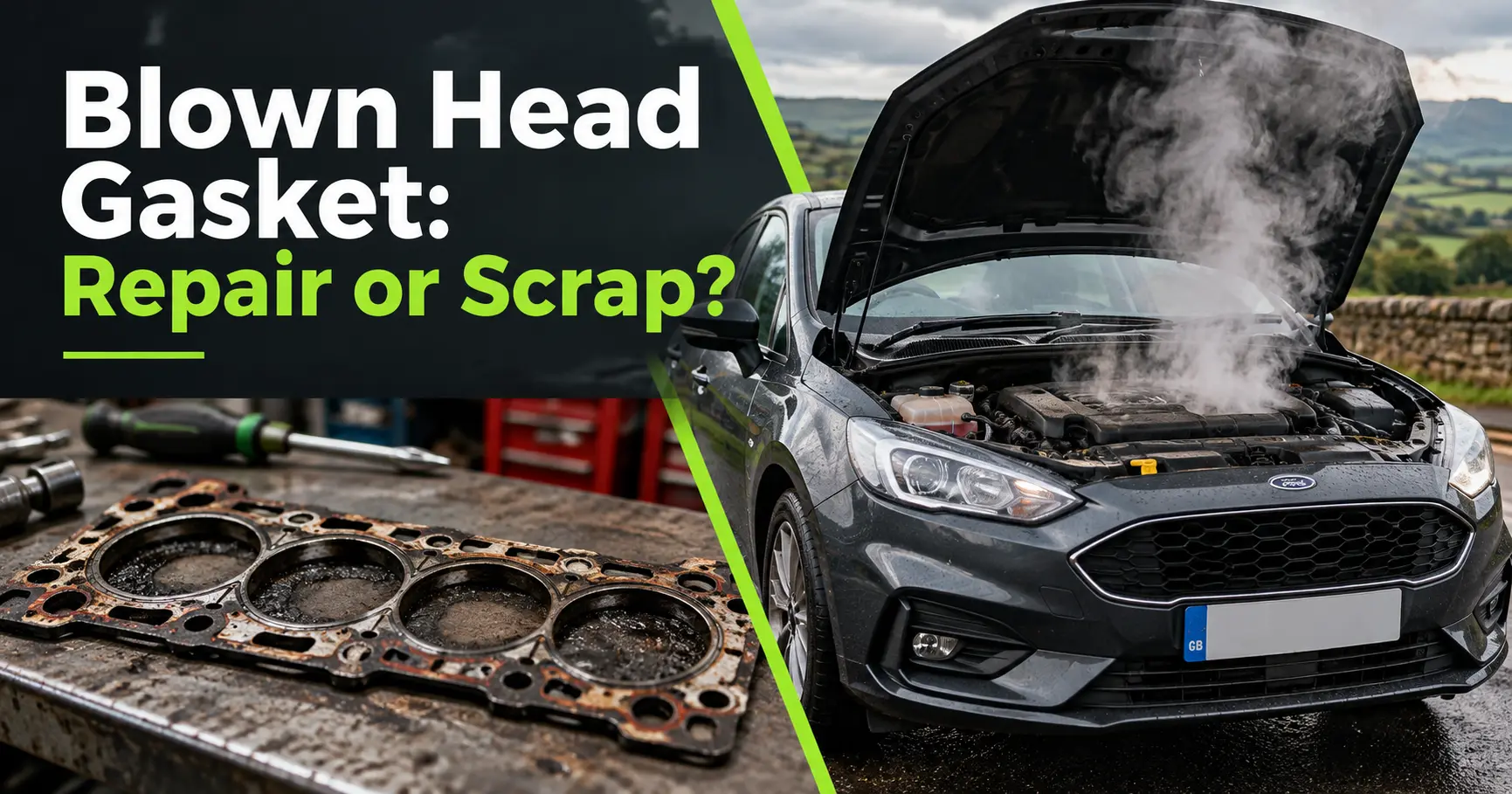
| Head gasket failure | £600 – £1,500 | Usually yes on high-mileage vehicles |
| Suspension subframe damage | £400 – £1,200 | Depends heavily on the vehicle’s overall value |
| Windscreen (chip or crack in critical zone) | £100 – £400 | Rarely by itself — depends on what else is wrong |
| EGR valve or lambda sensor | £150 – £500 | Only in combination with other expensive failures |
The table above shows individual items in isolation. In practice, a car failing its MOT on one expensive item usually has several other problems developing at the same time. An ageing diesel with a failed DPF typically also has worn brake discs, a tired exhaust, and suspension components approaching failure. The MOT failure is often the trigger that reveals a car has passed its economically viable life, rather than a single isolated problem that needs fixing.
Scrapping a Failed MOT Car in Greater Manchester: What to Expect
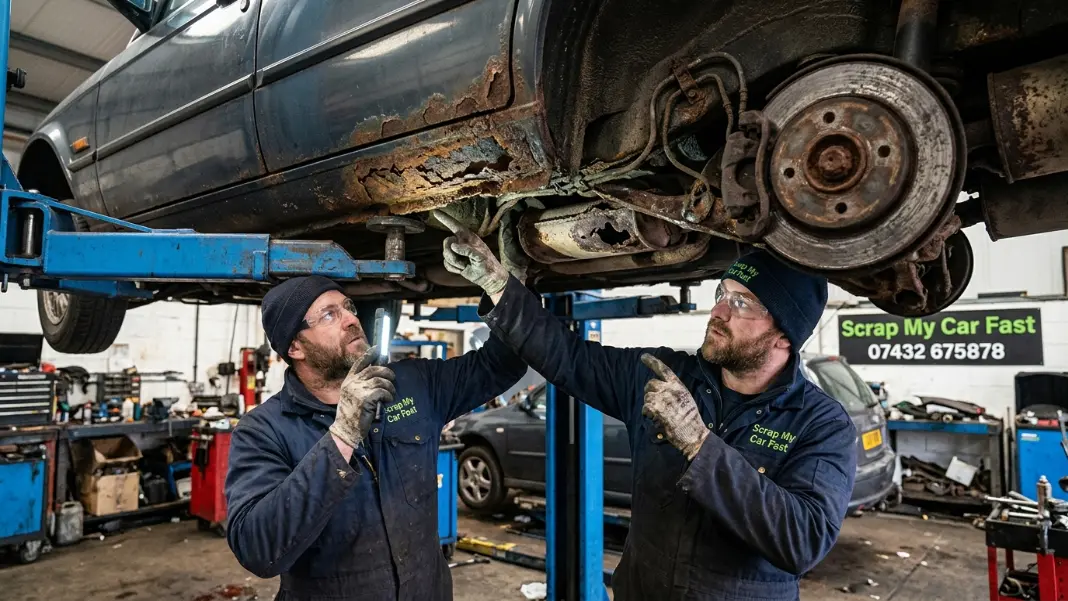
The process for scrapping a failed MOT car is identical to scrapping any other vehicle. MOT status is not asked about, not checked and not relevant to any part of the transaction.
Getting your quote. Enter your registration and postcode online. The system looks up your vehicle’s kerb weight from DVLA records and applies the current scrap metal rate. The MOT advisory sheet or failure notice plays no role in this calculation. The quote you receive is a firm price that does not change at collection.
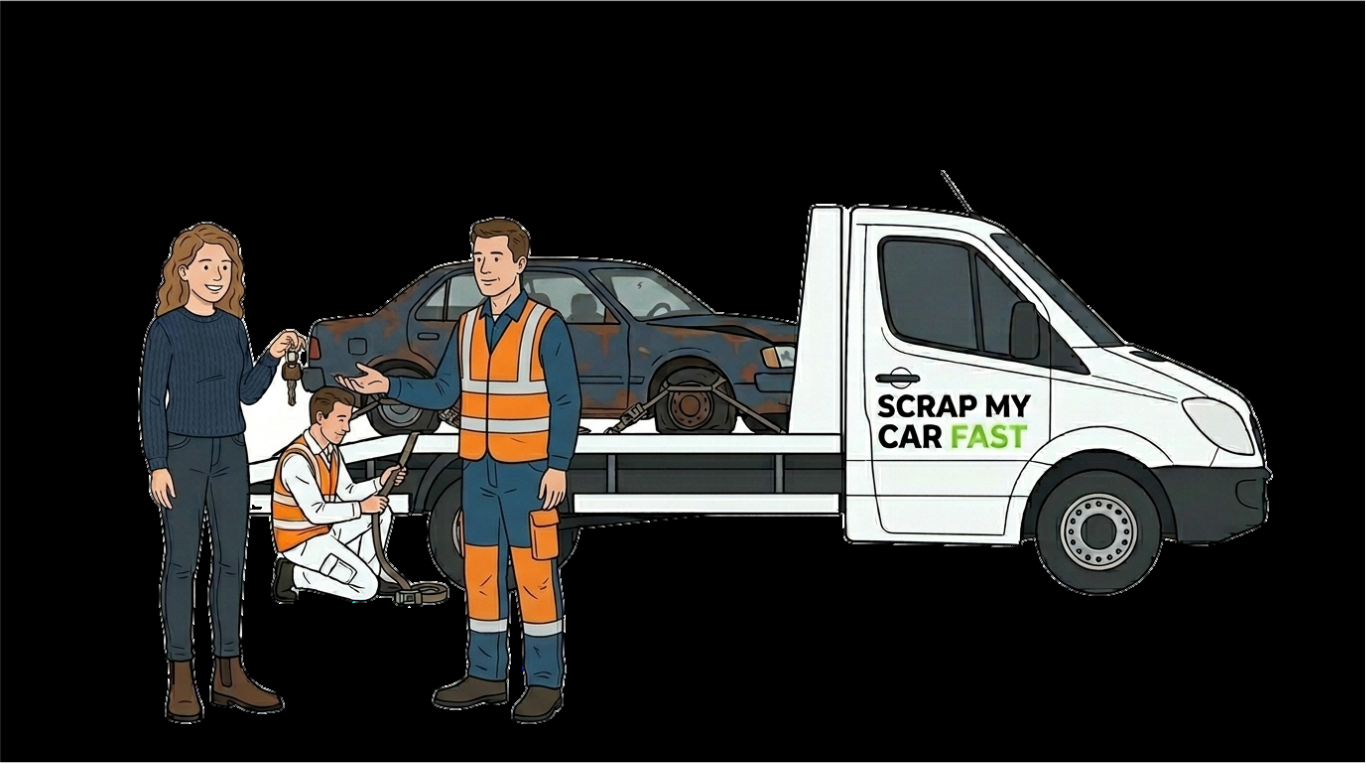
Booking collection. Choose a slot. We collect across all ten boroughs of Greater Manchester including Manchester, Salford, Stockport, Oldham, Bolton, Rochdale, Bury, Wigan, Tameside and Trafford. If the vehicle cannot be driven, we send a flat-bed or wheel-lift recovery vehicle and collect from your driveway, garage or any other private location. You do not need to move the car to the road.
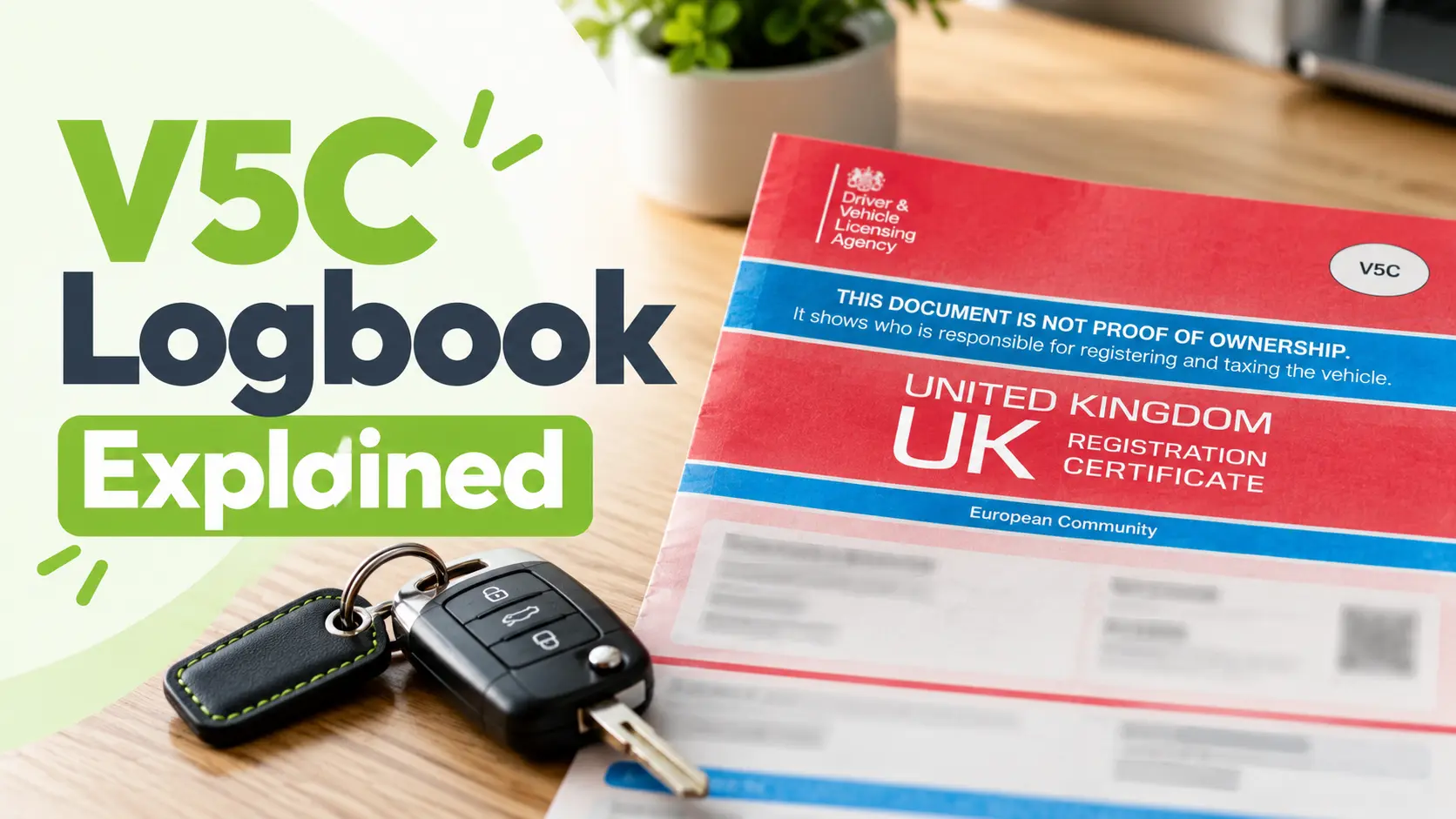
Documents needed. Bring valid photo ID (driving licence or passport). Bring the V5C logbook if you have it. MOT documentation does not need to be presented and does not affect anything about the transaction.
Payment. Bank transfer on the day of collection, processed the moment the vehicle is loaded. No cash, no cheques, as required by the Scrap Metal Dealers Act 2013. The amount transferred is the full quoted price with no deductions.
Certificate of Destruction. Issued on collection day and submitted to the DVLA electronically. The DVLA removes the vehicle from your name, cancels any remaining Vehicle Excise Duty and refunds any complete months of road tax that were paid in advance.
Can You Drive a Failed MOT Car to the Scrap Yard?
Only if your old MOT certificate is still valid and none of the faults were marked dangerous. If your MOT has expired, the only journeys allowed are to a garage for repairs or to a pre-booked MOT test, and a trip to a scrapyard is neither. If the car failed with a dangerous fault, it can’t be driven at all. The simplest option is a free collection from your drive or the test centre. For the full rules, see our guide on when you can and can’t drive after a failed MOT.
Declaring a SORN While You Decide
If the car is sitting off the road while you work out what to do, you should declare a Statutory Off Road Notification using the DVLA SORN service on gov.uk. A SORN means you are not legally required to pay road tax while the vehicle is not being used on a public road.
Once you scrap the car and the Certificate of Destruction is processed by the DVLA, the SORN becomes irrelevant. The vehicle is removed from DVLA records entirely and any remaining road tax is refunded automatically. You do not need to cancel the SORN separately.
A SORN vehicle cannot be driven on a public road. Do not attempt to move the car once the SORN is in place. The collection driver will handle loading from a private location without needing the vehicle to be on the public highway.
Does a Failed MOT Reduce the Scrap Price?
No. Scrap value is calculated from weight and the current price of scrap steel. MOT status, roadworthiness and mechanical condition are irrelevant. A car with four MOT failures and one with a freshly passed MOT have the same weight. At the scrap yard, they receive the same price.
The only vehicle characteristics that affect scrap value are:
- Weight (heavier vehicles are worth more)
- Presence of the catalytic converter (adds significant value due to platinum group metals)
- Overall completeness (missing body panels, wheels or major components reduce value)
A mechanically failed car that is physically complete will receive the same quote as an identical mechanically sound car. Do not repair or improve a car before scrapping it. The repair cost will not be recovered in the scrap price.
Frequently Asked Questions: Scrapping a Failed MOT Car
Can I scrap a car that has failed its MOT?
Yes. MOT status has no bearing on whether a car can be scrapped or on the price you receive. A licensed scrap dealer will collect and buy a failed MOT car in exactly the same way as any other vehicle. The scrap price is based on weight and metal value, not roadworthiness.
Do I need the MOT failure certificate when scrapping?
No. You need valid photo ID and ideally the V5C logbook, but MOT documentation is not required for a scrap transaction. The failure certificate is relevant only if you are arranging a retest or seeking a repair quote. It plays no role in the scrapping process.
How do I get a failed MOT car collected for scrapping?
Book a collection with a licensed scrap dealer by entering your registration and postcode online. If the car cannot be driven, confirm that a flat-bed or recovery vehicle will be sent. Collection from driveways, garages and private land is standard practice across Greater Manchester. Give the collector the location of the vehicle and they will handle the rest.
Will I receive a Certificate of Destruction for a failed MOT car?
Yes. The Certificate of Destruction is issued based on the vehicle being received by a licensed Authorised Treatment Facility. MOT status is not a factor. You will receive a CoD on collection day or within 24 hours, and the DVLA will be notified. The vehicle will be removed from your name and any remaining road tax will be refunded.
Should I repair my car before scrapping it?
No. Repair costs do not increase the scrap price. Scrap value is based on weight and metal, not on mechanical condition. Only repair the car if you intend to keep it or sell it privately, and only if the repair cost is meaningfully lower than the increase in market value the repair delivers.
What if my car is stuck at a garage after failing its MOT?
Contact the garage and confirm they are willing to release the vehicle to a collection driver. Then book a scrap collection and give the garage address as the collection location. The collection driver will handle the physical handover. Some garages charge a storage fee for vehicles left on their premises, so move quickly once you have decided to scrap. Most garages will hold a car for a few days without charge if you communicate your intentions promptly.