For most UK cars, catalytic converter scrap value sits between £20 and £250. Converters from hybrid cars such as the Toyota Prius, Toyota Auris and Honda Jazz hybrid are worth more, often £300 to £800. The price depends on how much platinum, palladium and rhodium is inside, and that comes down to the make, model and engine, and whether the part is original or an aftermarket replacement.
We collect scrap cars across Greater Manchester every week, and the catalytic converter is one of the first things we check when we price a car. Below you’ll find realistic 2026 values, the rules on selling one legally, and what to do if you go out to your car one morning and it starts up sounding like a tractor.
Quick facts
- Typical scrap value: £20 to £250 for most petrol and diesel cars, more for hybrids.
- Where the value comes from: platinum, palladium and rhodium coated inside the converter.
- Selling legally: only to a licensed scrap metal dealer, with photo ID, paid by bank transfer. Cash payments are banned under the Scrap Metal Dealers Act 2013.
- Driving without one: illegal on the road, and the car will fail its MOT.
- Most targeted cars: older Toyota, Lexus and Honda models, especially hybrids.
How much is a catalytic converter worth in scrap?
The honest answer is that it depends on the exact converter, but most fall into a fairly predictable range once you know what car they came from. Here is a rough guide to catalytic converter scrap prices in the UK, based on current trade prices and published buyer guides.
| Converter type | Typical UK scrap value (guide) | Why |
|---|---|---|
| Aftermarket replacement converter | £5 to £40 | Much thinner precious metal coating than the original part |
| Small petrol car (Ford Fiesta, Vauxhall Corsa, Nissan Micra) | £20 to £120 | Small unit, lower metal content |
| Diesel car | £30 to £250 | Uses more platinum. Some are combined with a diesel particulate filter, which makes value vary a lot |
| Larger or premium petrol car (BMW, Audi, Mercedes, larger engines) | £80 to £300 | Often bigger units, and some cars have two |
| Hybrid (Toyota Prius, Auris, C-HR, Lexus CT and RX, Honda Jazz hybrid) | £300 to £800+ | Higher precious metal content and usually less corroded |
Figures are a guide as of September 2026. Precious metal prices change daily, so a quote from a licensed buyer is the only way to get an exact number.
Why two converters that look the same can be worth very different amounts
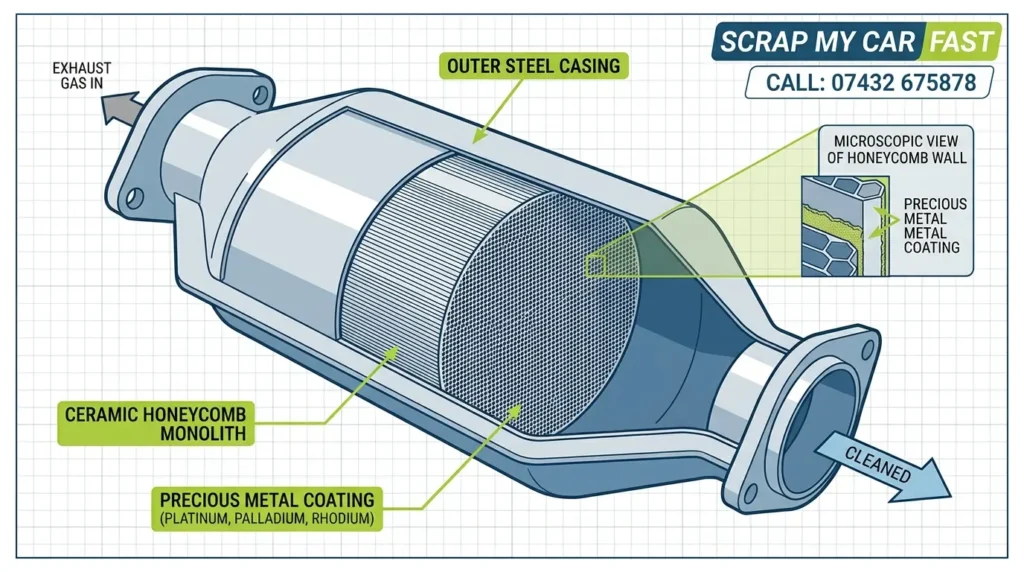
The steel shell is almost worthless. What buyers pay for is the ceramic honeycomb inside, which is coated with a small amount of precious metal. A typical car converter holds only a few grams of it in total, but rhodium in particular is worth far more than gold by weight, so a few grams adds up quickly.
Four things decide what a converter is actually worth:
- The car it came from. Manufacturers use different amounts of each metal. Japanese hybrids are known for high loadings, which is also why thieves go for them.
- Original or aftermarket. A factory-fitted (OEM) converter is worth far more than a cheap replacement. Aftermarket units carry just enough coating to pass emissions tests.
- Condition of the inside. If the honeycomb has cracked or collapsed, you’ll hear it rattle when you shake it. Some of the coated material has usually been lost, and the price drops.
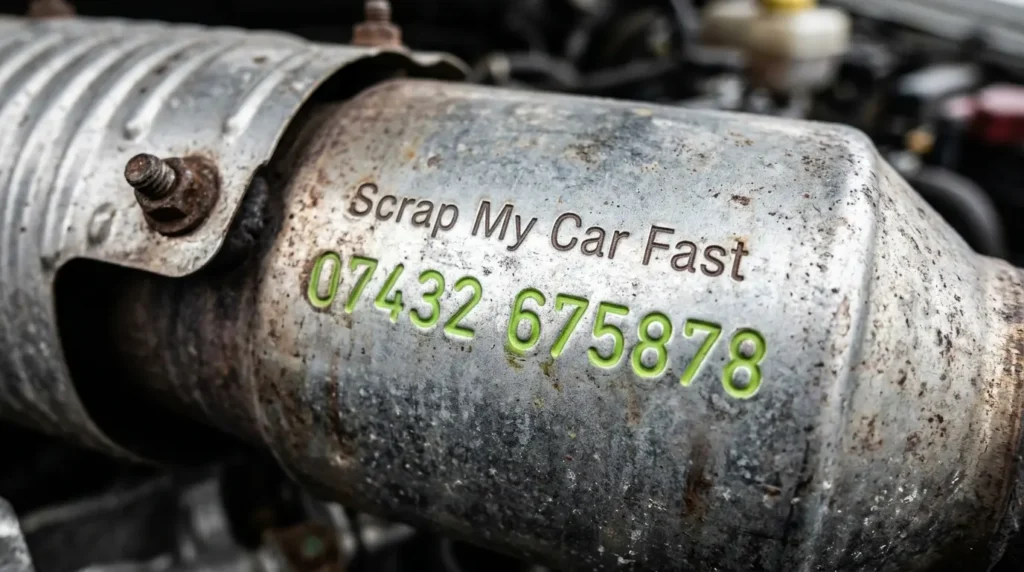
- The serial number. Most original converters have a code stamped on the casing. Buyers use it to look up the exact metal content, so a readable number gets you a more accurate quote.
Why catalytic converter scrap value changes month to month
Because converter prices track the global prices of platinum, palladium and rhodium, the same part can be worth noticeably more or less from one month to the next. Platinum and rhodium both climbed sharply through 2025, which pushed converter values up again after a quieter spell. That’s good news if you’re selling, but it’s also why thefts tend to rise whenever metal prices do.
If someone offers you a fixed price weeks in advance, or refuses to look at the part before quoting, treat that with caution.
Should you sell the catalytic converter separately or scrap the whole car?
If your car is going for scrap anyway, the catalytic converter is already part of the price you’re offered. When we quote for a car, we price it complete. If the converter is missing, the value comes down by at least what the converter would have been worth. On most everyday cars, an intact converter adds roughly £30 to £100 to a whole-car scrap quote, and more on hybrids and larger SUVs.
So removing it yourself rarely leaves you better off. You’d need to get the car up safely, cut or unbolt pipework that is often rusted solid, and disconnect the oxygen sensors without damaging them. Then you’d need to find a licensed buyer who will ask for proof that the part is yours. For most people the small gain isn’t worth the time or the risk.
There are two situations where selling it separately makes sense:
- You’ve had the converter replaced and kept the old original one. That part has no car attached, so selling it to a licensed buyer is the only way to get its value.
- You’re keeping the car and a garage has just fitted a new converter. Ask the garage for the old unit back rather than leaving it with them, then get it valued.
If you’re weighing up breaking a car for parts more generally, our guide on selling a car for parts vs scrapping it goes through the numbers. For how the rest of a scrap price is worked out, see how scrap car prices are calculated.
How to sell a catalytic converter legally in the UK
Catalytic converters count as scrap metal, so selling one is covered by the Scrap Metal Dealers Act 2013. The law was brought in partly to cut metal theft, and it gives you three simple checks when you sell:
- The buyer must hold a scrap metal dealer’s licence issued by their local council. A legitimate buyer will be happy to show it.
- They must check your ID and record your name and address before buying.
- They cannot pay you in cash. Payment has to be by bank transfer or cheque. We explain why in why scrap yards can’t pay cash.
To get the best legitimate price:
- Photograph the converter from both ends and get a clear shot of the serial number.
- Note the make, model, year and engine size of the car it came from.
- Get two or three quotes from licensed buyers, using the same photos for each.
- Take photo ID, plus anything that shows the part is yours, such as the V5C for the car or the garage invoice for the replacement.
Anyone offering cash, not asking questions, or buying from the back of a van without a licence is breaking the law. Selling to them can also tie you into an investigation if the part later turns out to be stolen.
Catalytic converter stolen? What to do, step by step
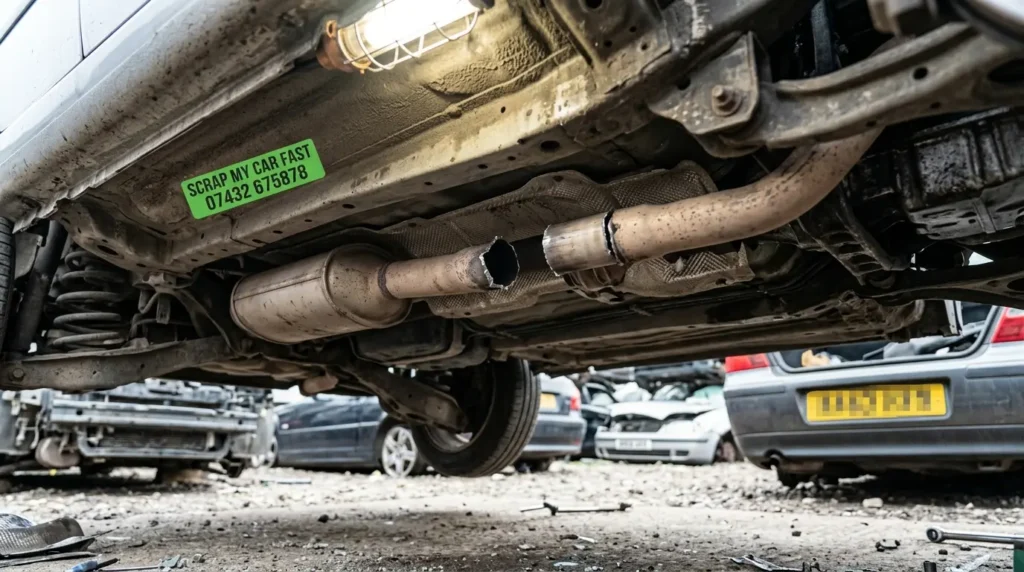
Most people find out the same way. They start the car and it roars like a racing car, or a loud rasping noise comes from underneath. You might also notice a cut section of pipe, a warning light on the dash, or a strong exhaust smell. On many hybrids the car will throw up a warning message or refuse to drive normally.
Here’s what to do next.
- Don’t keep driving it. A car without its converter doesn’t meet emissions rules, so it isn’t legal on the road. You risk a fine, and your insurer may push back on a claim if you carry on using it. Driving it can also damage oxygen sensors and loose wiring left behind by the thieves.
- Report it to the police and get a crime reference number. In Greater Manchester you can report it online through the Greater Manchester Police website or by calling 101. If you see someone under a car with a cutting tool, call 999.
- Call your insurer. Comprehensive policies usually cover theft of parts, less your excess. Third party, fire and theft cover varies, so check your policy wording. Ask whether a claim will affect your no claims discount.
- Get a repair quote. The converter itself might cost anywhere from about £150 to £1,000 depending on the model, plus fitting. Thieves often damage heat shields, sensors and pipework too, and once that is added, full repair bills of over £1,000 are common.
- Compare the repair bill with what the car is worth. This is the step that decides everything else.
When a stolen catalytic converter means it’s time to scrap the car
Thieves mostly target older hybrids and small Hondas, and many of those cars aren’t worth a great deal any more. That’s where the numbers stop adding up.
Take a typical example. A 2007 Honda Jazz is worth around £1,000. The garage quotes £1,100 to replace the converter, an oxygen sensor and the cut pipework, and the insurance excess is £250. The insurer may well decide the car isn’t worth repairing and write it off. If you don’t claim, you’re spending more than the car is worth to get it back on the road.
At that point you have three realistic options:
- Accept the insurer’s write-off payout. Our guide to what happens when your car is written off explains the categories and what you’re entitled to.
- Buy the car back and repair it yourself or through a cheaper garage, if you’re handy or know someone who is.
- Scrap the car or sell it as it is. We buy cars with missing or stolen catalytic converters. Tell us when you ask for a quote and the price will reflect it, so there’s no surprise on collection day. See our page on scrapping a damaged car or selling a written-off car.
Because the car can’t legally be driven, we collect it from your drive or the street at no cost.
Does a car fail its MOT without a catalytic converter?
Yes. If a car was built with a catalytic converter and it’s missing, that’s a major defect and an automatic MOT fail. The car will usually fail the emissions test as well. If your MOT is due and the repair isn’t worth it, have a look at our MOT failure scrapping service.
Which cars are most at risk of catalytic converter theft?
Thieves stick to cars they know well. They want a converter that’s quick to reach, holds plenty of metal, and hasn’t rusted onto the exhaust. Higher ground clearance helps them too, because they can get under the car without jacking it up.
Insurance and police data keep pointing at the same makes:
- Toyota and Lexus hybrids. Go.Compare’s figures named the Toyota Auris as the most targeted car in the UK, with roughly one in every 157 having its converter stolen in a year. The Lexus CT and Toyota Prius followed close behind.
- Honda. Five Honda models appeared in the same top ten, including the Jazz, CR-V, Accord and FR-V.
- Newer hybrids. DVLA figures for 2025 put the Toyota C-HR hybrid at the top of the UK’s most stolen cars list. Its converter is one of the reasons it’s attractive to thieves.
In Greater Manchester, as in most cities, these thefts tend to happen on residential streets overnight and in busy car parks during the day. Thieves sometimes wear hi-vis so they look like they’re doing a repair. A crew with a battery grinder can have a converter off in a couple of minutes.
How to protect your catalytic converter
No single measure stops a determined thief, but each one makes your car a slower, riskier target, and that’s often enough for them to move on.
- Park smart. Use a garage if you have one. On a drive, park with the exhaust side close to a wall or fence. On the street, choose well-lit spots near other cars.
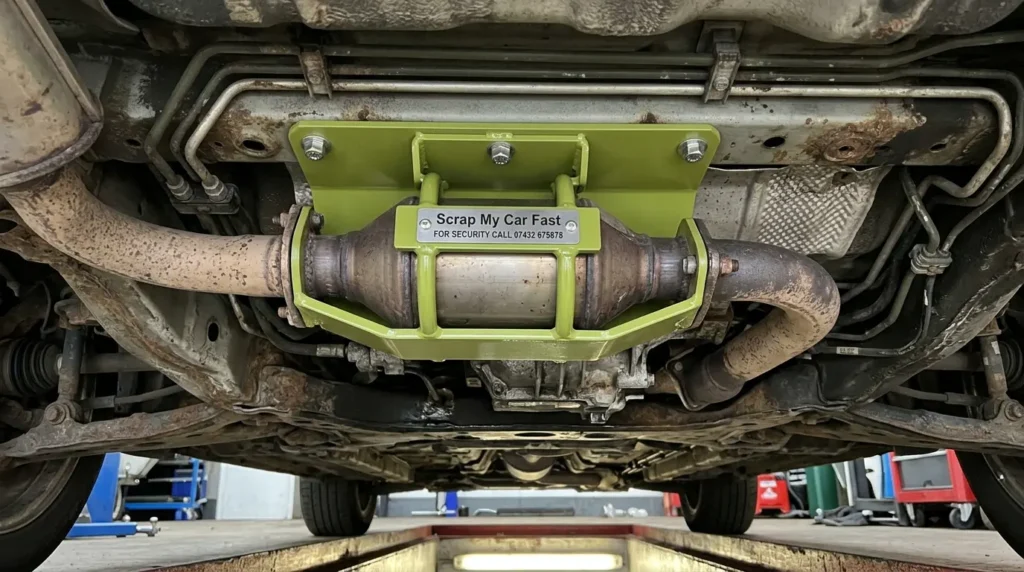
- Fit a converter lock or shield. A cage or plate bolted over the converter means thieves need more time and more noise to get it off. Look for Thatcham-approved products.
- Mark it. Forensic marking kits and engraving your registration or VIN on the casing make a converter harder to sell through a licensed dealer. Some police forces run free marking events, so it’s worth checking.
- Use an alarm with a tilt sensor. It sounds if the car is jacked up, which a standard alarm won’t pick up.
Frequently asked questions
Can I scrap my car if the catalytic converter has been stolen?
Yes. An authorised scrap car buyer can still take the car, recycle it and issue a Certificate of Destruction. The price will be lower than for a complete car, because the converter is one of its most valuable parts. Mention it when you ask for a quote so the price is accurate from the start.
How do I find out what my catalytic converter is worth?
Find the serial number stamped on the casing, note the car’s make, model and engine, and send clear photos to two or three licensed scrap metal buyers. Online price lists give a rough idea, but a quote based on the actual part is far more reliable.
Why are catalytic converters from hybrid cars worth more?
Hybrid converters generally carry a heavier coating of platinum group metals. The engine also switches off often, so the converter runs cooler and tends to be in better condition with less corrosion. Both push the scrap value up.
Is it legal to sell a catalytic converter for cash?
No. Under the Scrap Metal Dealers Act 2013, licensed dealers in England and Wales can’t pay cash for scrap metal, including catalytic converters. You’ll be paid by bank transfer or cheque, and you’ll need to show ID.
Does car insurance cover a stolen catalytic converter?
Comprehensive policies usually cover it, minus your excess. Third party, fire and theft policies vary, so check your documents. If your car is older and the repair costs more than it’s worth, your insurer may write the car off instead of repairing it.
Can I drive my car without a catalytic converter?
Not legally. The car won’t meet emissions standards, it will fail its MOT, and you could be fined. It may also affect your insurance if you’re stopped or involved in an accident.
Do electric cars have catalytic converters?
No. Fully electric cars have no exhaust, so there is no converter to steal. Hybrids do have one, because they also have a petrol engine, and that’s why they’re so heavily targeted.
Scrap a car with a missing or stolen catalytic converter in Greater Manchester
If your car has lost its converter and the repair bill doesn’t make sense, we can take it off your hands. Get an instant scrap car quote, tell us the converter is missing, and we’ll give you a straight price with free collection. We cover Manchester, Salford, Stockport, Bolton and the rest of Greater Manchester. Payment goes straight to your bank account, and we handle the DVLA paperwork.