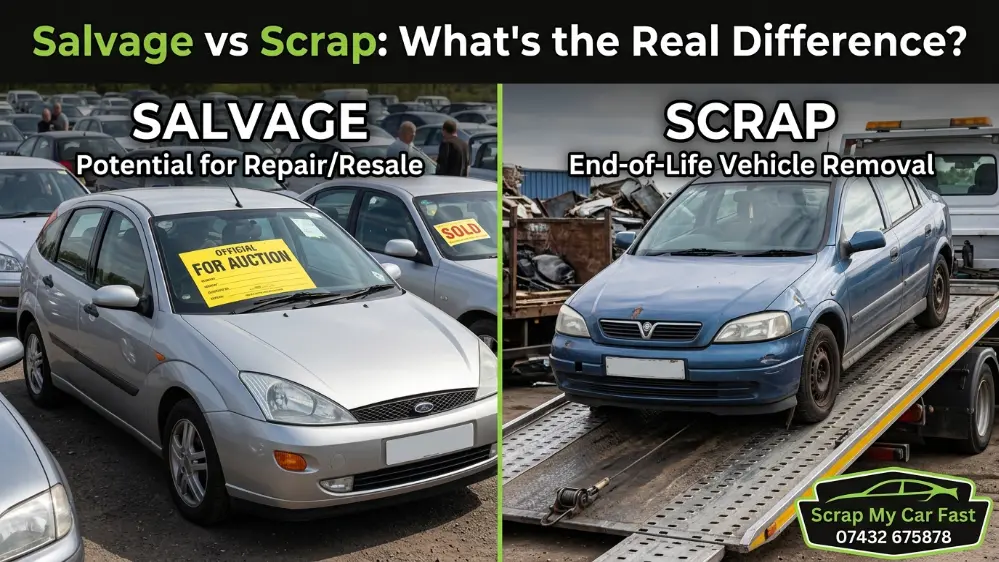
People use “salvage” and “scrap” as though they mean the same thing, and it’s easy to see why. Both usually come up after a car’s been in an accident, both involve getting rid of a vehicle you no longer want, and both sound fairly final. They’re not the same thing at all, though, and knowing which one actually applies to your car changes what you’re legally allowed to do with it and how much sense each route makes.
This guide explains the real difference, how salvage auctions like Copart actually work, whether selling on one yourself is realistic, and how to work out whether salvage or straightforward scrapping suits your particular car.
What Does “Salvage” Actually Mean?
A salvage vehicle is one that’s been damaged, usually through an accident, flood, fire, or theft recovery, but which still has enough remaining value that someone, somewhere, wants to buy it, repair it, or strip it for parts. Salvage is essentially the used car trade’s word for “damaged but still worth something to the right buyer.” A car doesn’t have to be a write-off to be described as salvage, but most salvage vehicles that reach an auction have gone through an insurance write-off process first, and carry one of the four categories, Cat A, Cat B, Cat S, or Cat N, that insurers use to describe the extent of the damage. If you want the full detail on what each of those categories actually means and what you’re legally allowed to do with your car under each one, our guide on insurance write-off categories explained covers that properly.
Scrap is a different concept entirely. Scrapping a car means it’s being permanently destroyed for its raw materials, mainly the steel, other metals, and recyclable components, with no expectation that it’ll ever be driven again. There’s no repair angle, no resale to another owner, no second life. Once a car is scrapped through a licensed Authorised Treatment Facility, it’s gone for good, and you’re issued a Certificate of Destruction confirming exactly that.
Salvage vs Scrap: The Core Difference
The simplest way to think about it is this. Salvage assumes someone else might want the car, whether that’s a bodyshop repairing a Cat N vehicle for resale, or a breaker stripping a Cat B shell for parts before the body is destroyed. Scrap assumes nobody does, and the car’s only remaining value is what’s inside it once it’s been crushed and processed.
This matters practically because a Cat A car has no salvage route available at all, it must be destroyed, full stop. A Cat B car can have parts salvaged but the shell still has to be destroyed. A Cat S or Cat N car genuinely can go either way, repaired and sold on as a salvage vehicle, or scrapped if the numbers don’t stack up. Whether yours falls into the “worth salvaging” camp or the “better off scrapped” camp usually comes down to the car’s age, how desirable the model is, and how much of the damage is genuinely repairable.
How Salvage Auctions Like Copart Actually Work
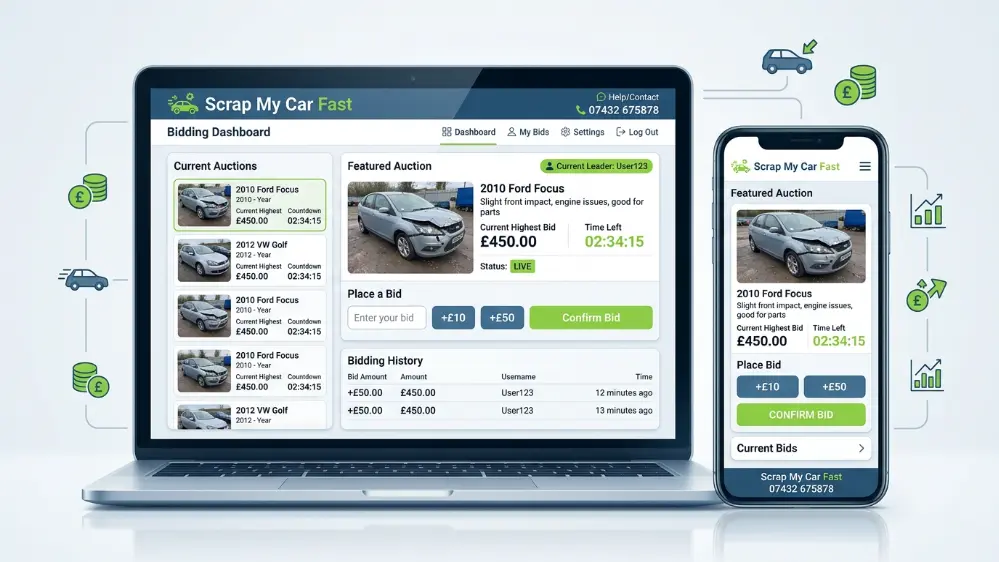
Copart is the name most people have heard of, and it’s a genuinely large operation, handling several hundred thousand vehicles a year across sites all over the UK. It works as an online bidding platform. Vehicles are listed with photos, damage descriptions, mileage, and their insurance category, and registered members bid on them, either live during a scheduled auction window or through a pre-bid set in advance up to a maximum amount.
A few practical details matter here if you’re thinking about this route. Buyers generally need to pay for membership and sometimes a buyer’s fee on top of the winning bid, and vehicles cannot simply be driven away from the yard, the winning bidder has to arrange their own collection or transport. Sellers, meanwhile, often set a reserve price, and if bidding doesn’t reach it, the car doesn’t sell on that attempt, and the process starts again.
Can You Sell Your Own Damaged Car on a Salvage Auction Yourself?
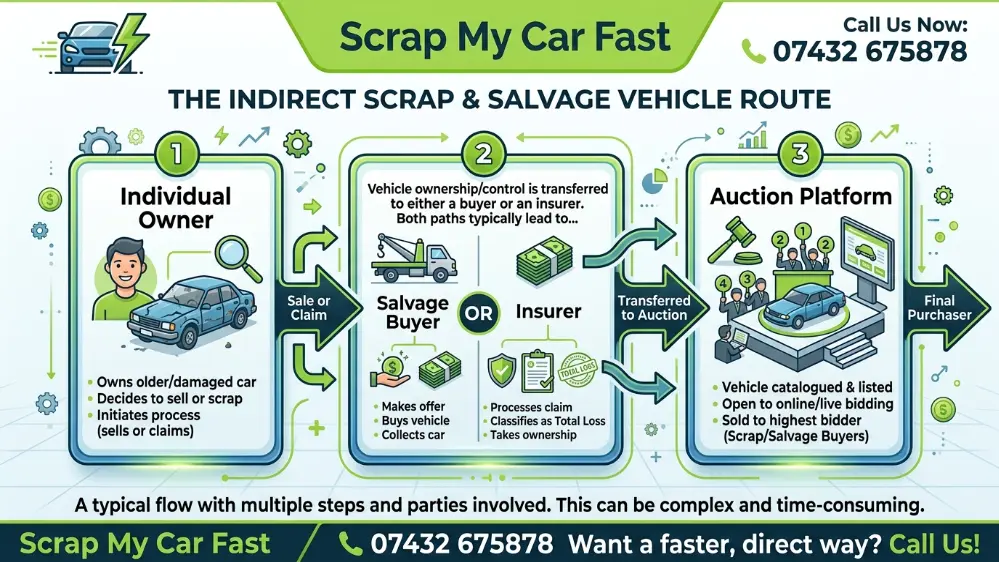
This is the part that catches a lot of people out. Platforms like Copart are built primarily around insurers, fleet companies, and trade sellers listing large volumes of stock, not individual owners turning up with one damaged car to list themselves. If you’ve got a single written-off or damaged vehicle and you’re not already set up as a trade seller, going direct to an auction platform yourself usually isn’t a straightforward option. Most private individuals in this position either go through their insurer’s salvage buy-back process, or use a specialist salvage buyer or comparison service that lists the vehicle on their behalf, taking a cut in the process.
The Practical Downsides of the Auction Route for an Individual
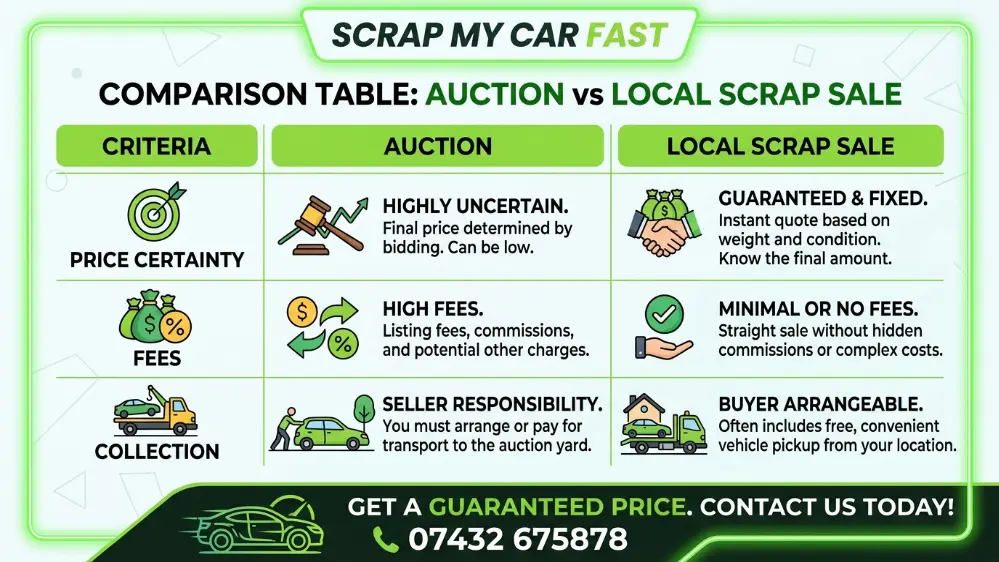
Even where it is possible, there are a few real drawbacks worth knowing before you go down this path. The final price isn’t guaranteed, if your reserve isn’t met, you don’t sell and you’re back where you started. Fees eat into whatever you do get, both from listing and from any intermediary handling it on your behalf. You’re also on a timetable that isn’t yours, waiting for the right auction slot rather than getting a number today. And crucially, this route only makes sense at all for cars with genuine remaining value, a desirable model with mild, clearly repairable damage. A Cat A or Cat B car, or anything genuinely old and heavily worn, simply won’t attract meaningful bids regardless of how it’s listed.
When Salvage Makes Sense vs When Scrap Makes Sense
If your car is a newer or more desirable model, the damage is non-structural or only moderately structural, and you’re confident there’s real buyer demand for a repair project, it’s worth at least getting a comparison quote from a specialist salvage buyer before deciding. If your car is older, has failed multiple MOTs in the past, has extensive damage, or falls into Cat A or Cat B territory, chasing a salvage sale is usually a waste of time and effort. In that situation, a straightforward scrap valuation based on weight and current metal prices will almost always net you a comparable, or better, and far more certain, outcome, with no bidding, no reserve price, and no waiting on someone else’s auction calendar.
What Determines Whether a Damaged Car Has Real Salvage Value
Not every damaged car is a realistic salvage candidate, even if the category technically allows repair. A handful of factors decide whether a Cat S or Cat N vehicle is genuinely worth pursuing through the salvage route rather than simply scrapping it. The make and model matter enormously, popular, in-demand cars with a healthy supply of spare parts attract far more interest from repairers and parts buyers than an obscure or unpopular model. The type of damage matters too, cosmetic and electrical faults are cheaper and easier to put right than anything touching the chassis, suspension mounts, or safety systems, which is part of why Cat N vehicles generally hold their salvage value better than Cat S ones. Age plays a role as well, since a five-year-old car with moderate damage is a far more attractive repair project than a fifteen-year-old one, where the repair cost can easily exceed what the finished, repaired car would actually be worth.
The Hidden Costs of Chasing a Salvage Sale
Beyond the auction fees and uncertain reserve price already mentioned, there are a few less obvious costs worth weighing up if you’re considering the salvage route yourself. Getting an accurate photo set and damage description together takes real time and, ideally, some knowledge of what buyers actually look for, a poorly described listing attracts fewer bids and a lower price. If you’re going through an intermediary or specialist buyer rather than listing directly, their commission comes straight out of whatever the car eventually sells for. And if the car doesn’t sell at your first attempt, you’re often looking at weeks before the next suitable auction slot comes round, all while the vehicle sits taking up space and, in some cases, continuing to depreciate the longer it waits.
A Simpler Comparison: Get Both Numbers First
If you’re still unsure which route suits your specific car, the most sensible approach is simply getting a number from both sides before committing to either. A specialist salvage buyer or auction listing will give you an idea of what a repair-focused buyer might pay, while our scrap car calculator gives you a guaranteed, no-obligation scrap figure in under a minute for comparison. There’s no downside to checking both, and for a lot of older or heavily damaged cars, the scrap figure ends up being the more realistic and considerably faster option once fees, uncertainty, and waiting time are factored into the salvage route.
Getting a Straightforward Cash Offer Instead
If salvage doesn’t suit your car, or you’d simply rather have a guaranteed number today than an uncertain one in a few weeks, our scrap car calculator gives you an accurate figure in under a minute, based on your car’s weight and the current scrap metal rate. There’s no membership fee, no bidding, and no reserve price that might not be met. If the damage came from an accident, our scrap accident damaged car service is built specifically for that, and if you’ve already had a category confirmed by your insurer, sell written off car covers exactly what we need from you to get moving.

How the Collection Process Works
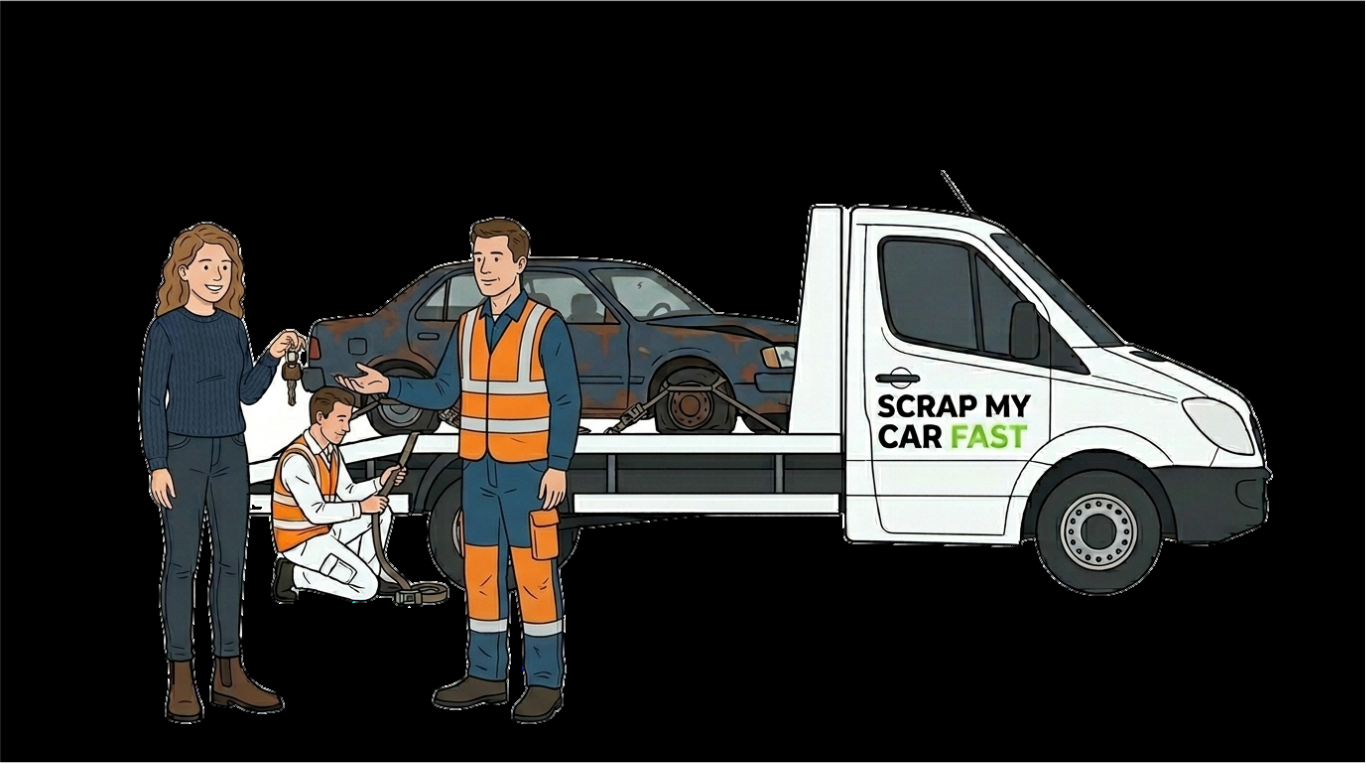
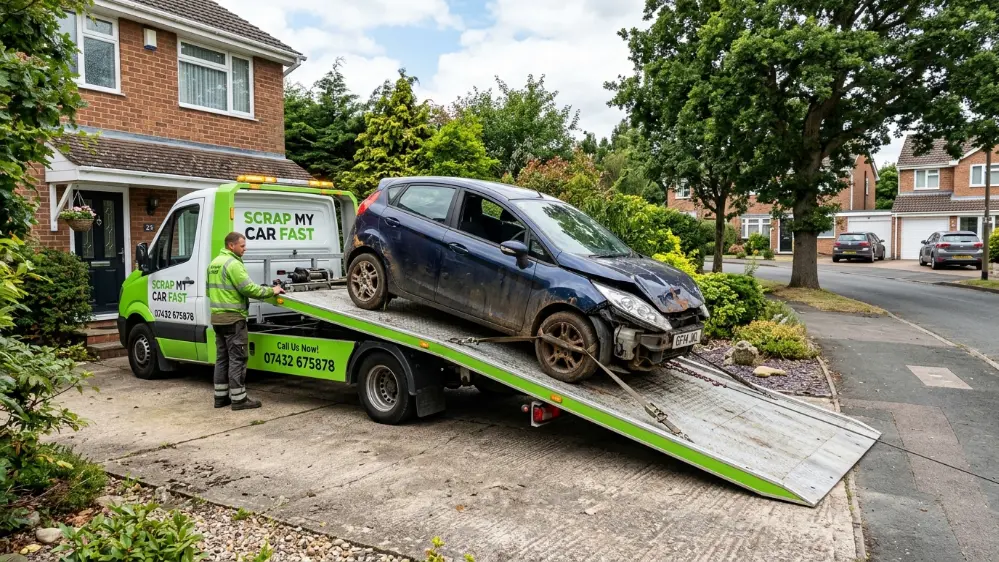
Once you’ve got a quote you’re happy with, we collect free of charge from anywhere across Manchester and the wider Greater Manchester area, including Stockport and every other borough, with full flatbed and winching capability for vehicles that can’t be driven at all. That’s a genuine practical advantage over the auction route, where arranging transport for a damaged, non-running vehicle is entirely down to the buyer. You’re paid by bank transfer the same day the car leaves your property, and you get a Certificate of Destruction if the car is going for scrap rather than repair. If you’re specifically dealing with accident or fault-related damage rather than a straightforward write-off, our scrap my damaged car service covers that too.
Frequently Asked Questions
What’s the difference between a salvage car and a scrap car? A salvage car is damaged but still has enough value that someone might repair or strip it for parts. A scrap car is being permanently destroyed for its raw materials with no expectation of a second life.
Can I sell my own damaged car on Copart myself? Not usually as a straightforward, one-off listing. These platforms are built around trade and insurer sellers, handling large volumes of stock daily. Most individual owners with a single damaged vehicle go through their insurer’s salvage buy-back option or a specialist buyer instead, rather than listing directly themselves.
Is scrapping easier than using a salvage auction? Yes, generally. Scrapping gives you a firm, guaranteed price today with free collection, whereas an auction route involves fees, an uncertain reserve price, and arranging your own transport.
Does a Cat A or Cat B car have any salvage value? Cat A cars must be fully destroyed with no salvage route at all. Cat B cars can have individual parts sold, but the body shell still has to be destroyed, so there’s no route to a repaired, driveable car in either category.
How do I know if my car is worth more as salvage or scrap? It generally comes down to the model’s desirability, the extent and type of damage, and the car’s age. Newer, more desirable models with limited, repairable damage suit the salvage route better. Older, heavily damaged, or high-mileage cars are usually better off scrapped for a guaranteed price, without the added time and fees a salvage sale typically involves.
Not sure which route suits your car? Get an instant quote and we’ll give you a straightforward number, no bidding, no reserve, no waiting.