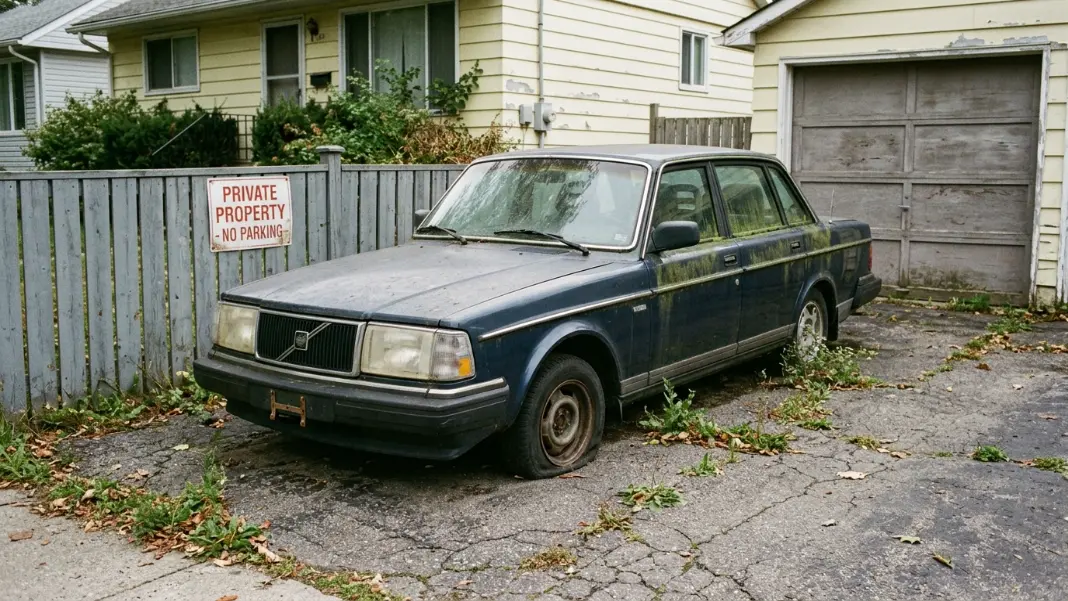
There is a car on your land that does not belong to you. Maybe it turned up on your driveway one morning and nobody knows who owns it. Maybe a customer parked in your business car park three weeks ago and never came back. Maybe a neighbour left it on your shared forecourt and is not picking up calls.
The first thing most people do is ring the council. And in most cases the council tells them the same thing: sorry, we cannot help with that, it is on private land.
That answer leaves people stuck. You know the vehicle needs to go. You just do not know how to make it happen without doing something that could land you in legal trouble.
This guide goes through everything you need to know. What your rights are as a landowner in England and Wales, the exact process to follow, how long you have to wait, whether you can ever scrap an abandoned car and get paid for it, and what the situation looks like specifically across Bolton and Greater Manchester.
Why the Council Cannot Help You (And This Is the Part Most People Get Wrong)
When a vehicle is abandoned on a public road or in a council-managed car park, local authorities have legal powers under the Refuse Disposal (Amenity) Act 1978. They can inspect the vehicle, trace the registered keeper, issue a removal notice and arrange collection. The whole process is their responsibility.
But when a vehicle is on private land, those powers simply do not exist. The council has no legal authority to step onto your property and remove someone else’s car, regardless of how long it has been sitting there or how bad it looks.
If the car is on a public road or pavement rather than on your private land, the process is completely different. We cover the public road reporting process across Greater Manchester in our guide on what to do about an abandoned car in the UK.
The private land situation sits in civil law, not local authority enforcement. That means the responsibility is yours, the process is on you, and you need to follow a specific set of steps to protect yourself legally when you eventually have the vehicle removed.
How to Tell If a Car Is Legally Considered Abandoned
There is no single definition in UK statute for what counts as an abandoned vehicle on private land. In practice, a vehicle is treated as abandoned when all of the following apply:
- It was left without your permission
- The registered keeper either cannot be traced or has not responded to contact
- There are clear signs the vehicle is no longer in use (no current tax, flat tyres, visible deterioration, smashed glass, no plates)
- A reasonable period has passed with no attempt by anyone to retrieve or claim it
That phrase “reasonable period” is important. Courts do not expect you to wait indefinitely, but they do expect you to have made genuine efforts to find the owner and given them a fair window to collect the vehicle before you take action. In most cases, seven to fourteen days after formal notice is considered the minimum. Longer is safer, particularly if the vehicle still has some visible value and the owner might later claim they had no idea you were going to remove it.
What You Are and Are Not Allowed to Do
As the landowner, you have the right to have the vehicle removed. But only through the correct process. Understanding what you cannot do matters just as much.
You are not allowed to:
- Have the car towed away immediately without any notice or attempt to contact the owner
- Damage the vehicle or remove parts from it
- Sell or scrap it before exhausting reasonable efforts to locate the owner
- Clamp it yourself (private clamping without a government-authorised operator licence is an offence under the Protection of Freedoms Act 2012)
You are allowed to:
- Issue a formal written notice giving the owner a set timeframe to collect the vehicle
- Arrange removal once the notice period has expired without response
- Attempt to recover your removal costs through the small claims court if the owner is later identified
- Ultimately dispose of the vehicle through an authorised facility if the owner cannot be traced and all proper steps have been completed
Step by Step: The Correct Process for Removing an Abandoned Vehicle From Your Land
Step 1: Document Everything From Day One
Before you do anything else, photograph the vehicle in detail. Capture the registration plate, the make and model, the condition of the bodywork, any pre-existing damage, and the exact position on your land. Include timestamps. Photograph it again every few days.
This documentation is your protection. If an owner later surfaces claiming the vehicle was in better condition or was not where you said it was, your date-stamped photographs are what proves the facts.
Step 2: Attempt to Trace the Owner Through the DVLA
Run the registration plate through the DVLA’s free vehicle enquiry service at gov.uk/check-mot-history. This gives you basic information about the vehicle including whether it has current tax and MOT, but it does not give you the keeper’s name or address.
To formally request registered keeper details, you need to write to the DVLA directly. Understanding how the DVLA holds vehicle records is useful context here, our guide on notifying the DVLA when scrapping a car explains how keeper records work and what happens when a vehicle is formally taken out of use.
When writing to request keeper information, send your letter to DVLA, Swansea, SA99 1BD. Include the vehicle registration number, a clear explanation that the vehicle is on your private land without permission, and your contact details. The DVLA will decide whether your reason justifies releasing the keeper’s information. They do not always respond quickly, so do this early.
Step 3: Issue a Formal Written Notice on the Vehicle
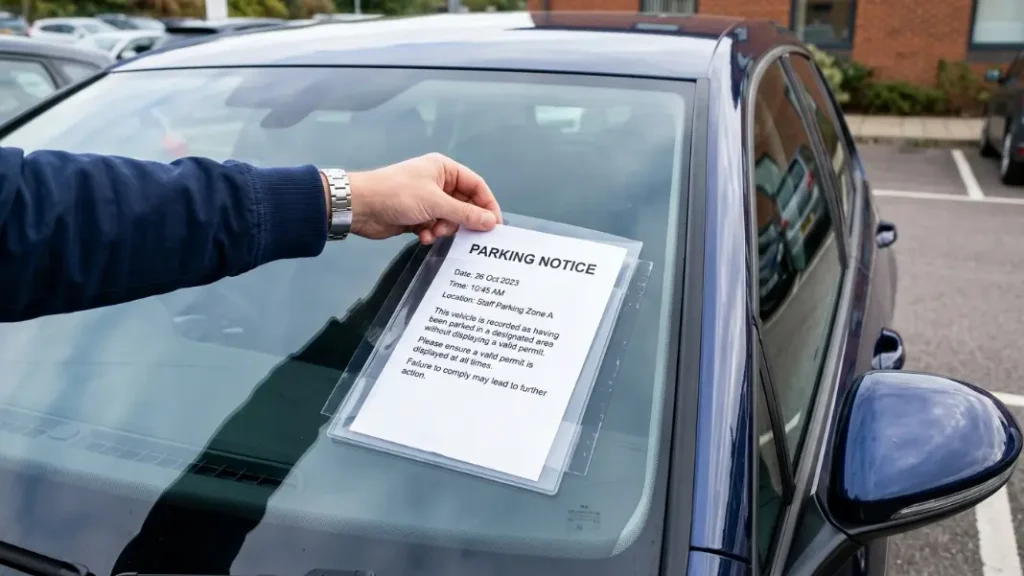
Regardless of whether you have obtained keeper details yet, write a formal notice and fix it to the vehicle. Place it inside a clear plastic sleeve tied to the windscreen wiper or taped to the windscreen where it is clearly visible and protected from rain.
Your notice should state:
- The date of issue
- The registration, make, model and colour of the vehicle
- That the vehicle is parked on private land without permission
- A firm removal deadline (at minimum 7 days, ideally 14)
- Your contact details for the owner to arrange collection
- A clear statement that if the vehicle is not collected by the deadline, it will be removed at the owner’s cost
Keep a copy. Photograph the notice in position on the vehicle. If you obtained keeper details from the DVLA, also send a copy by recorded post to the registered address and keep your proof of postage.
Step 4: Wait the Full Notice Period
Do not remove the vehicle before the deadline you stated. If you do, you are exposed to a claim under the Torts (Interference with Goods) Act 1977 for wrongful interference with another person’s property. In practice, prosecutions of landowners acting in good faith are rare, but a civil claim from a returning owner could still cost you more time and money than simply waiting it out.
If the owner contacts you during the notice period, continue the conversation in writing where possible. If they agree to collect the vehicle, get a date confirmed in writing.
Step 5: Arrange Collection Once the Deadline Passes
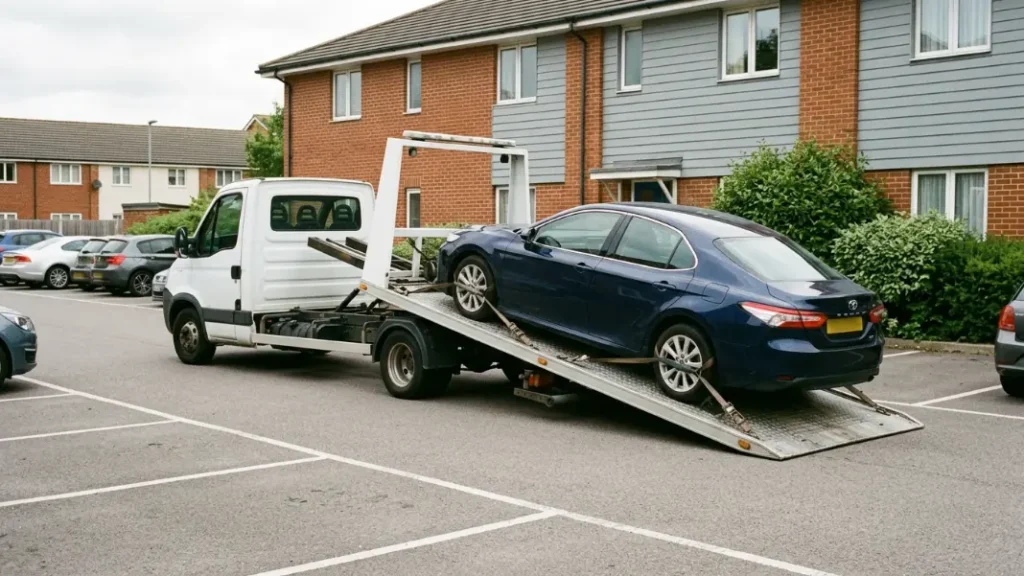
If the deadline comes and goes with no contact and no collection, you can now act. Your options at this point are:
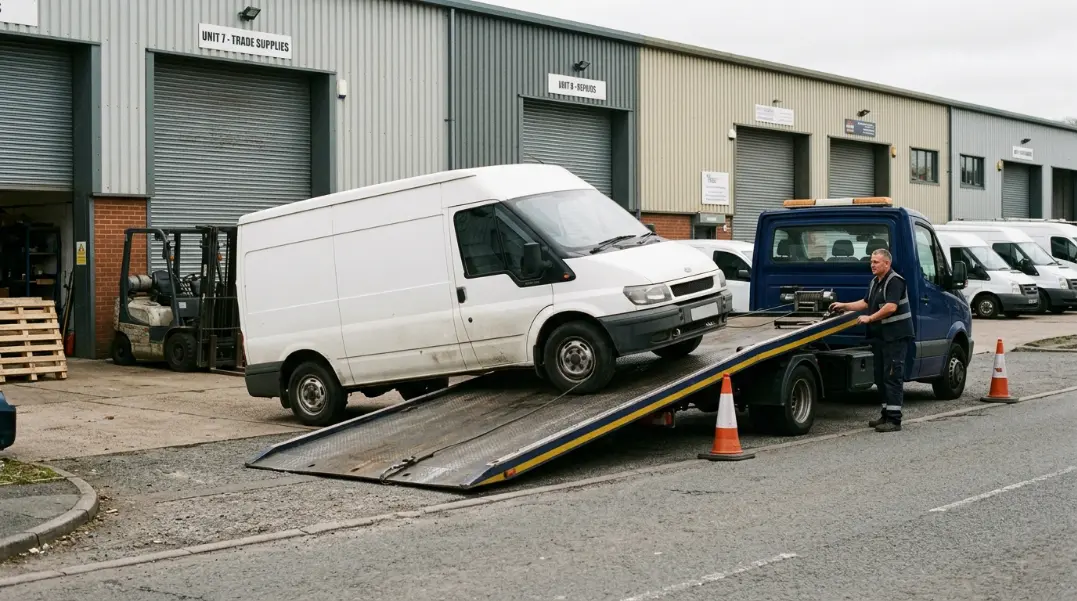
- Hire a private recovery company to tow the vehicle away and store it pending contact from the owner
- Contact a scrap car collection service to collect and dispose of it through a licensed facility
- Arrange collection yourself if you have the equipment and authority to do so
The question most landowners then face is whether they can recover any scrap value from the vehicle.
Can You Scrap an Abandoned Car on Your Land and Get Paid for It?
Sometimes, yes. But it is more complicated than calling a scrappy and asking them to take it.
Every legitimate scrap car buyer in the UK is required to operate as an authorised treatment facility, and an ATF must verify that the person handing over a vehicle is entitled to do so, whether that means they are the registered keeper or someone with documented authority to dispose of it.
If you can show your notice documentation, your DVLA correspondence, and your photographic record to a reputable ATF, many will work with you to handle the collection, particularly if the vehicle is on private land and you can demonstrate clearly that the owner has abandoned it and cannot be traced.
If the owner is completely untraceable and you have followed every step correctly, a solicitor can advise on whether a statutory declaration is appropriate. This is a formal sworn statement confirming the facts and your authority to dispose of the vehicle. It gives the scrap operator an additional layer of protection for their own records.
In virtually all abandoned vehicle cases, the V5C logbook will not be present in the car. Our guide on scrapping a car without a V5 logbook covers how reputable ATF collectors handle situations where the registration document cannot be produced.
What If the Car Has No Plates or Cannot Be Identified?
A vehicle with no registration plates, a scrubbed VIN and no identifying markings is the hardest situation. Without a registration you cannot run a DVLA check and you have no obvious route to tracing the keeper.
Do the following:
- Call the police on 101 and report the vehicle as unidentified and suspected abandoned on your private land. Get a crime or incident reference number.
- The police can sometimes access the VIN stamped on the chassis or under the bonnet even without plates and may be able to trace a keeper that way
- Document the police report number and keep it with all your other evidence
- Some scrap collection services will proceed with a police log number alongside your landowner documentation
The Situation in Bolton: What the Council Does and Does Not Cover
Bolton Council runs an abandoned vehicle reporting service, but it only covers vehicles on public roads and public-owned land across the borough. If you are in Bolton and the car is on your private driveway, business premises or private car park, the council team will not remove it.
If the vehicle is on the boundary of public and private land, or partially blocking a public road, it is still worth reporting. They may be able to act on the public portion and the resulting council activity sometimes prompts the owner to deal with the whole situation.
Bolton Council abandoned vehicle reports for public roads can be made at bolton.gov.uk or by calling 01204 333 333. If you need a scrap car collected from anywhere in Bolton, we cover the full borough including BL1 through to BL7 and out to the borough boundaries.
Manchester and Salford: The Same Rules Apply
Manchester City Council handles abandoned vehicle reports on public roads through its street scene reporting portal. Salford City Council routes them through Salford Online. Both follow the same basic framework as Bolton for public land: verify, trace, notice, remove.
For private land situations anywhere across Greater Manchester, the council cannot act regardless of borough. Whether you are in Salford, Trafford, Tameside, Oldham or anywhere else in the region, the civil law process described in this guide is what you follow.
What Happens If You Just Move It Without Following Any Process?
It comes up constantly. Can you just have it towed to the road and let the council deal with it from there?
The short answer is no, and it is not worth the risk. Moving someone else’s vehicle without following the notice process is technically wrongful interference with goods. The Torts (Interference with Goods) Act 1977 gives property owners rights over their vehicles even when those vehicles are in a state of complete disuse.
A returning owner who finds their vehicle has been moved without notice, even if they had clearly abandoned it, could bring a civil claim. Courts have sided with landowners who followed proper process and acted reasonably, but landowners who skipped steps have found themselves facing unexpected bills.
The correct process takes around two to three weeks from start to finish. That is not much time to protect yourself from a dispute that could take months and significant legal costs to resolve.
Preventing It From Happening Again
If this has happened once on your land, it can happen again. A few basic measures make it significantly less likely:
- Install clear signage at every access point stating that the land is private property and unauthorised vehicles will be removed at the owner’s expense. Make the signs large and visible.
- Add physical access controls where practical, such as lockable bollards, barriers or gates that can be secured outside business hours
- For ongoing commercial car park management, look into a managed enforcement contract with a DVSA-registered parking operator. These are legitimate and provide a formal structure for dealing with unauthorised vehicles without putting the burden on you each time.
- Install CCTV at entry and exit points. Beyond deterrence, you will have registration data for any vehicle that enters and cannot be claimed later to have arrived overnight with no trace.
Frequently Asked Questions
How long does a car have to be abandoned before I can remove it from my private land?
There is no fixed statutory period for private land in English law. Courts expect landowners to have made genuine efforts to contact the owner and issued a notice giving a reasonable time to collect, typically a minimum of 7 days and ideally 14. The longer you wait and the more documented your attempts to contact the owner, the stronger your legal position if a dispute arises later.
Can the council remove a car from my private driveway?
No. Local councils in England and Wales have no legal powers to remove vehicles from private land. Their abandoned vehicle powers under the Refuse Disposal (Amenity) Act 1978 apply only to public roads, public car parks and publicly adopted land.
Can I scrap an abandoned car on my land if the owner never comes back?
Potentially yes, after completing the full notice and tracing process. You will need to demonstrate to the scrap collection service that you have followed the correct procedure and have authority to dispose of the vehicle. Keeping all your documentation throughout the process is essential.
What if the abandoned car has no MOT, no tax and no number plates?
A vehicle in that condition is still legally someone’s property until it is formally scrapped or the owner is confirmed untraceable. For a vehicle with no plates specifically, report it to police on 101 first and obtain an incident number before proceeding. Our guide on selling or scrapping a car without MOT or tax covers the legal background for these vehicles in more detail.
Who pays for the removal of an abandoned vehicle from private property?
You will typically need to cover the initial removal cost. If you can identify the owner afterwards, you can pursue them for your reasonable costs through the small claims court. In practice, owners of genuinely abandoned vehicles are often untraceable, so recovery of costs is not guaranteed.
Do I need any paperwork after the car has been scrapped?
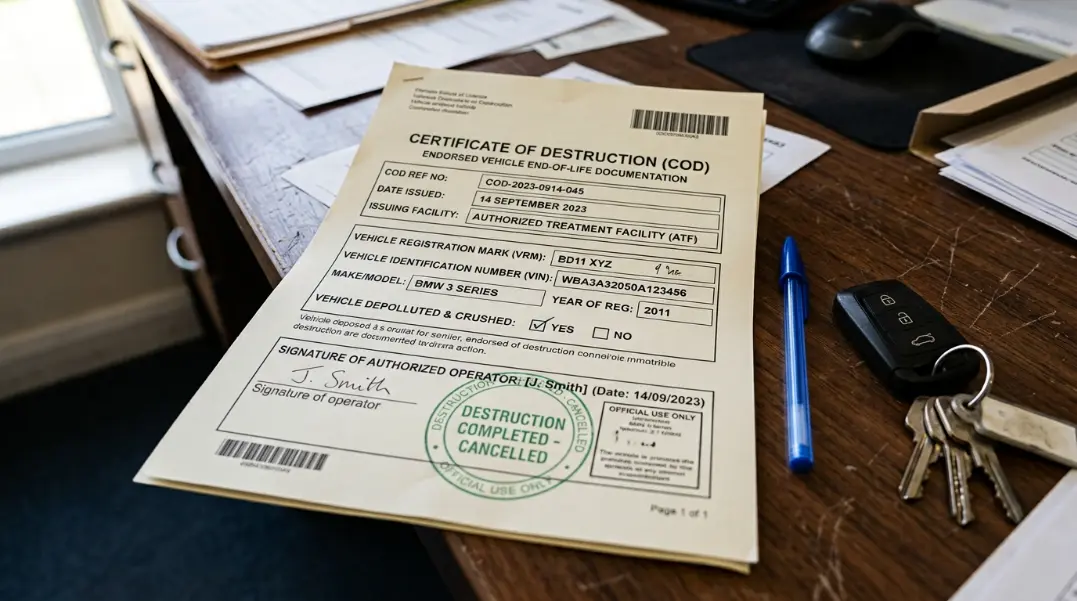
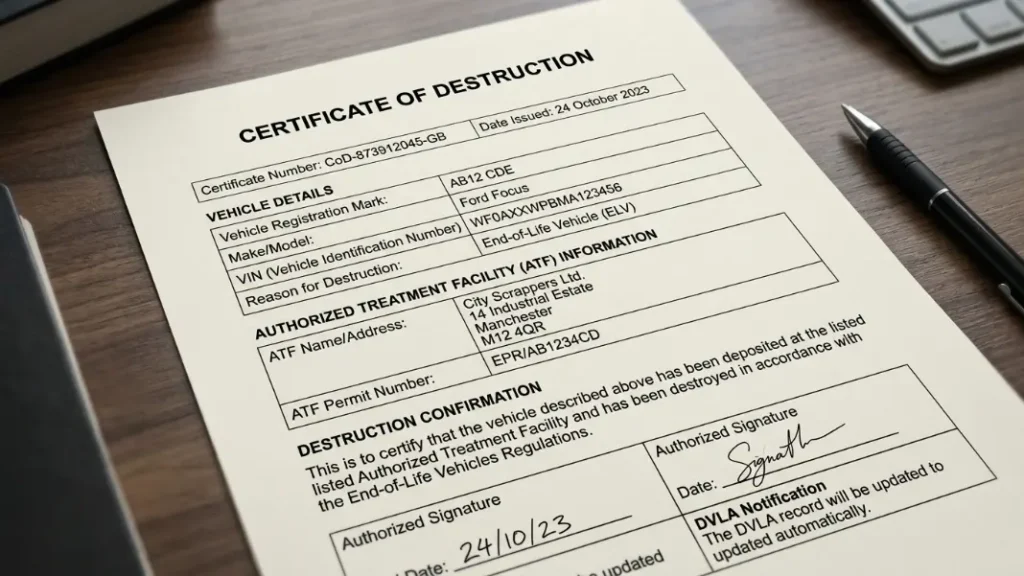
Yes. When the vehicle is collected by a licensed ATF, you should receive a Certificate of Destruction. This is the official record that the vehicle has been deregistered and processed. Keep it. It confirms the vehicle is no longer your legal responsibility in any form.
Getting It Removed Across Greater Manchester
If you have followed the process, served your notice, waited out the deadline and still need the vehicle gone from your land across Bolton, Salford, Manchester, Stockport, Bury, Rochdale, Oldham, Wigan, Tameside or Trafford, we can help.
We operate as a fully licensed authorised treatment facility. We handle collections from private land, work through the documentation requirements with you, issue a Certificate of Destruction for every vehicle, and take care of all DVLA notification on your behalf. Get a free quote today and we can talk through your specific situation before we come out.