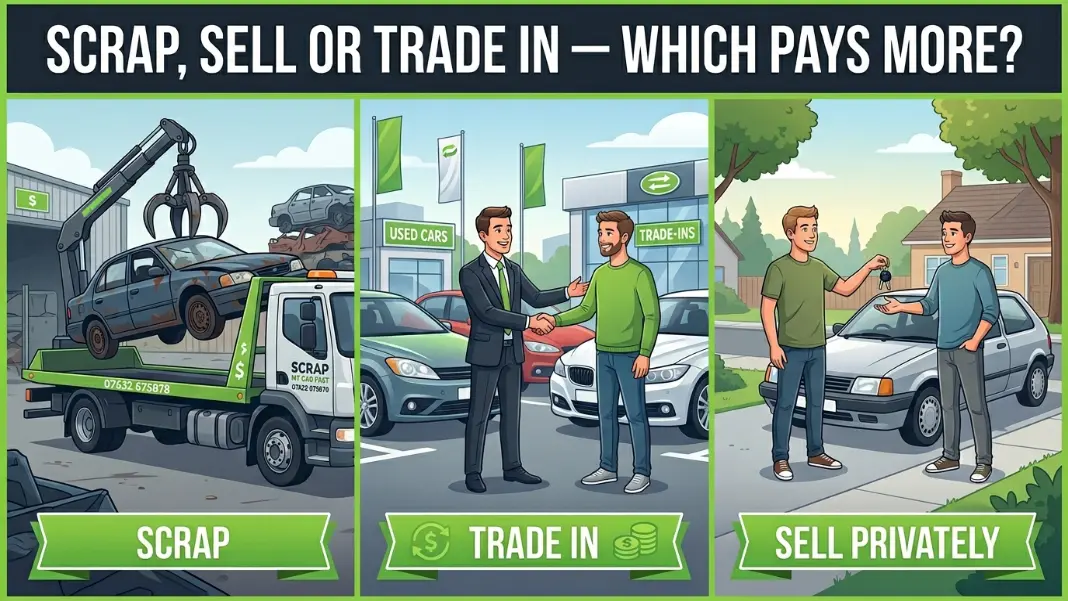
When you want to get rid of a car, you have three main options: scrap it, part exchange it at a dealership, or sell it privately. Each route delivers a different amount of money and demands a different level of effort. Which one wins for you depends on the car’s condition, its age and value, and honestly how much time you are prepared to spend. This guide breaks down all three so you can make the call with actual numbers.
The Three Options at a Glance
Here is how scrapping, part exchange and private sale compare across the factors that most people care about:
| Factor | Scrap | Part Exchange | Private Sale |
|---|---|---|---|
| Amount received | Lowest — based on metal weight | Middle — trade value | Highest potential — market value |
| Time to complete | Same day | Same day | Days to months |
| Effort required | Very low | Low | High |
| Condition required | None | Roadworthy preferred | Good condition important |
| MOT required | No | Preferred but not always | Yes, in almost all cases |
| Payment type | Bank transfer on collection day | Reduction off new car price | Cash or transfer on sale |
| Risk of transaction failing | None | None | Buyer pullouts, scams, disputes |
| Best for | Old, damaged or non-running cars | Buying from a dealer at the same time | Cars worth over £3,000 in good shape |
The table gives you the shape of the decision. The sections below go deeper so you can apply the logic to your specific car.
Option 1: Scrapping
How the Price Is Calculated
Scrap value is determined by two things: the kerb weight of your vehicle and the current market price for scrap steel. Catalytic converters add a premium because they contain platinum group metals: platinum, palladium and rhodium, which are recovered by specialist smelters and are significantly more valuable than steel by weight. A complete vehicle with its catalytic converter intact will always receive a higher quote than one that has been stripped or had the catalytic converter removed.
Typical scrap values in Greater Manchester at current rates look like this:
| Vehicle Type | Typical Kerb Weight | Approximate Scrap Value |
|---|---|---|
| Small hatchback (Fiesta, Corsa, Polo) | 1,000 – 1,200 kg | £180 – £290 |
| Medium hatchback or saloon (Focus, Astra, Golf) | 1,200 – 1,450 kg | £220 – £350 |
| Large saloon or estate (Mondeo, Passat, Octavia) | 1,450 – 1,700 kg | £280 – £430 |
| SUV or crossover (Qashqai, Kuga, Tucson) | 1,600 – 2,000 kg | £320 – £520 |
| Large 4×4 or SUV (Discovery, Range Rover Sport) | 2,000 – 2,800 kg | £440 – £720 |
| Large van (Transit, Sprinter, Crafter) | 1,800 – 3,500 kg | £380 – £780 |
Scrap metal rates fluctuate with global commodity markets. The figures above are representative but will vary depending on the rate on the day you book. The quote you receive is based on the rate at the time of booking and is typically held for a few days to cover your collection slot.
When Scrapping Makes Sense
Scrapping is the right choice when the car cannot be driven or does not have a current MOT, when the private sale value is within a few hundred pounds of the scrap price after accounting for the effort of selling, when the car needs repairs that you do not want to fund, or when you simply want the situation resolved quickly without hassle.
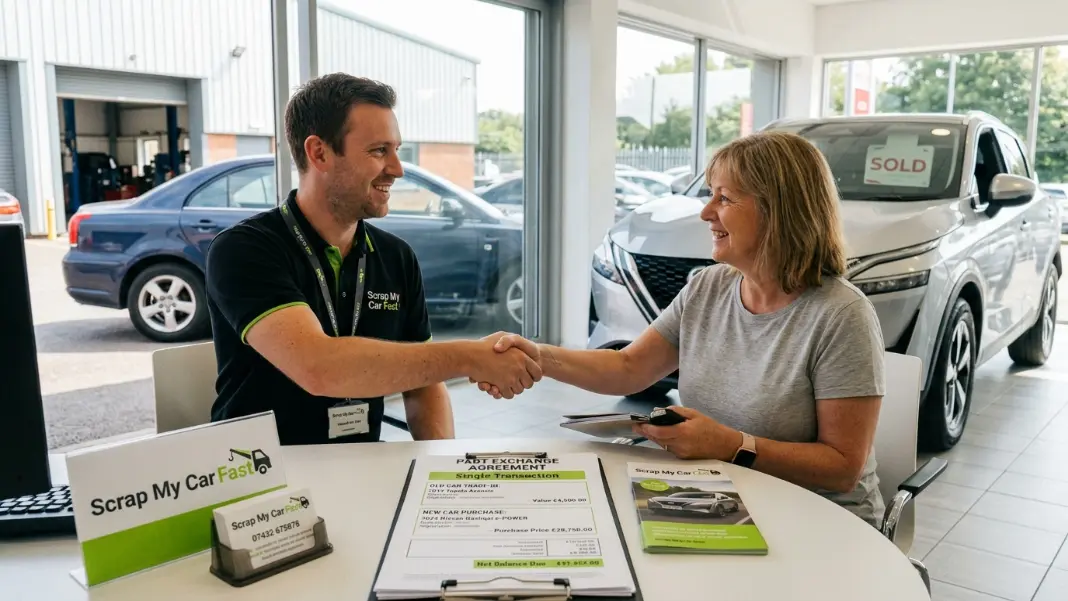
For cars over 12-15 years old with high mileage, mechanical issues or significant bodywork problems, private sale often delivers only marginally more than the scrap price once advertising costs, preparation and time are factored in. In those cases, scrapping is not just the easiest option, it is often the most rational one financially.
The Costs That Do Not Exist With Scrapping
Scrapping has almost no transaction costs. Collection is free. There are no platform fees, no advertising costs, no commission, no deductions from the quoted price. The Certificate of Destruction is issued at no cost. The amount you are quoted is the amount that hits your bank account on collection day.
Option 2: Part Exchange
How Part Exchange Valuations Work
Part exchange means handing your car to a dealer as part payment for a vehicle they are selling. The dealer values your car and subtracts that amount from the price of the replacement vehicle. You do not receive cash directly. You receive a reduction in what you owe for the new car.
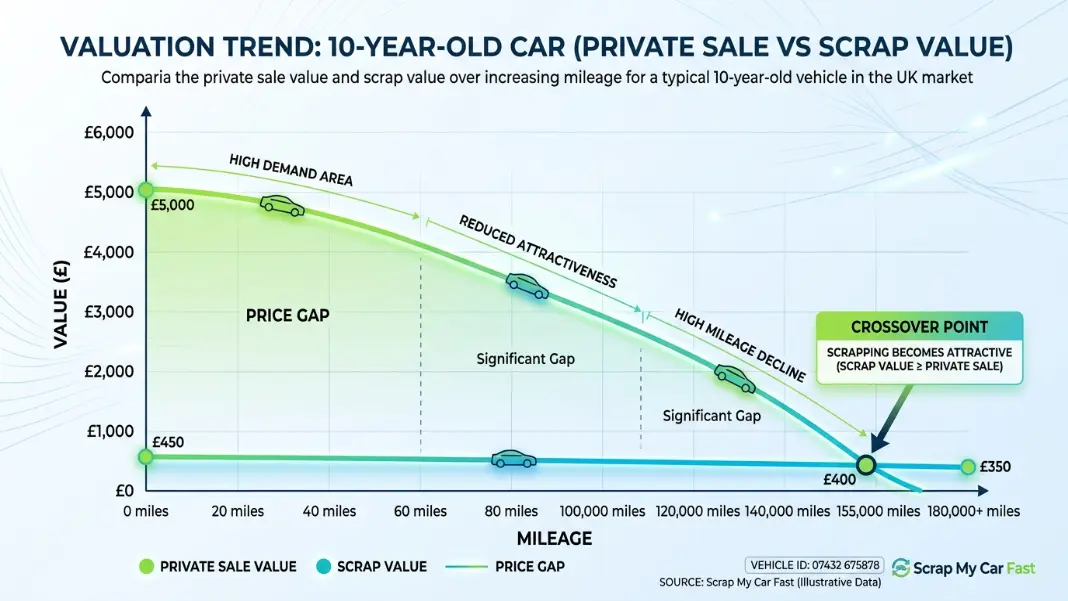
Part exchange prices are lower than private sale prices because the dealer needs to make a profit on your old car. They will either retail it themselves, send it to trade auction, or pass it to a scrap dealer if it is not retail-worthy. The gap between what they give you and what they can recover is where their margin sits.
As a general benchmark:
| Private Sale Value | Typical Part Exchange Offer | Approximate Discount vs Private Sale |
|---|---|---|
| £500 – £2,000 | £300 – £1,300 | 30% to 40% less |
| £2,000 – £6,000 | £1,400 – £4,500 | 20% to 30% less |
| £6,000 – £15,000 | £5,000 – £12,500 | 12% to 20% less |
| Over £15,000 | Variable | 8% to 15% less |
These are approximations. Dealers in competitive markets, or those who need a specific type of used car to fill a gap in their forecourt, may offer closer to private sale value. Dealers who are clearing space and have limited appetite for older used stock may offer at the low end.
When Part Exchange Makes Sense
Part exchange makes sense when you are definitely buying a replacement car from a dealer and you value the simplicity of completing everything in a single transaction. You avoid running two cars simultaneously, you do not need to organise separate insurance, and the entire deal completes in one afternoon.
Part exchange does not make sense as a standalone option if you are not buying from a dealer. And it makes less sense when the gap between the part exchange offer and the private sale value is large enough that the extra effort of selling privately would be well rewarded.
How to Get a Better Part Exchange Deal
Before walking into a dealership, get an online instant offer from services such as We Buy Any Car, Motorway or Cazoo. These give you a baseline trade value that you can use as a reference point when the dealer makes their offer. If the dealer’s part exchange valuation is significantly below what an online buyer would pay, you have grounds to push back.
Dealers often prefer to negotiate on the new car price rather than the part exchange value because it feels like a bigger concession to the buyer. But the number that matters is the total difference: what you pay for the new car minus what you receive for the old one. Keep your focus on the net cost of the transaction, not on any single line item.
Option 3: Private Sale
What You Actually Get After Costs
Private sale delivers the highest gross amount, but gross is not what you take home. The realistic net amount after advertising costs, preparation, time and the risk of failed sales is frequently lower than the headline private sale price suggests.
The real costs of selling privately include:
| Cost | Typical Amount |
|---|---|
| Advertising (premium listing, two to four weeks) | £30 – £120 |
| Professional valeting to show the car well | £60 – £200 |
| Minor cosmetic repairs to improve saleability | £0 – £500+ |
| New MOT if the existing one is close to expiry | £45 – £80 |
| Time (enquiries, viewings, test drives, handover) | 8 to 25 hours |
| Risk of buyer pulling out after agreed sale | Wasted time — restart the process |
| Risk of post-sale dispute or warranty claim | Variable — potentially significant |
The dispute risk is worth understanding properly. Selling as a private individual means selling as seen. Buyers who experience a problem after purchase sometimes attempt to pursue a claim against a private seller, particularly if they argue that a fault was present but not disclosed. Most private sales complete without issues, but a proportion lead to disputes that generate stress and occasionally financial cost that outweigh the benefit of selling privately over trading in or scrapping.
When Private Sale Makes Sense
Private sale makes financial sense for cars worth over £3,000 to £4,000 in good, roadworthy condition where the gap between private sale value and the alternatives is substantial. For a car worth £9,000 privately and offered at £7,000 as part exchange, spending several weekends to sell privately can net you £1,500 to £2,000 extra after advertising and preparation costs. That is a meaningful return for your time.
Private sale becomes questionable as values drop. For a car worth £1,500 privately and offered at £1,000 in part exchange, the £500 premium requires weeks of effort, carries the risk of buyer problems, and often ends with a price reduction anyway. At that value level, the effort-adjusted return from private sale is marginal.
What About Online Car Buying Services?
Services like We Buy Any Car, Motorway, Arnold Clark Sell Your Car and Cazoo sit between part exchange and private sale. You receive a guaranteed price, typically close to trade value, with minimal effort and no buyer risk. These platforms work well for cars in the £2,000 to £20,000 range where the difference between their offer and private sale value is acceptable given the convenience.
For cars at the lower end of the value spectrum, online buying services may add handling fees that significantly reduce the net amount, or may decline to make an offer at all. For higher-value cars, their offers can undercut private sale value by enough that the extra effort of selling privately becomes worthwhile.
For cars at or near scrap value, online buying services generally do not make competitive offers. In this range, scrapping through a licensed operator delivers a better net result with no fees and same-day payment.
A Side-by-Side Comparison: Two Real Scenarios
To make this concrete, here is how the numbers work out for two representative vehicles.
Scenario A: 2018 Volkswagen Golf 1.5 TSI, 52,000 miles, full service history, current MOT
| Route | Gross Amount | Costs and Deductions | Net to You |
|---|---|---|---|
| Private sale | £12,500 | Advertising £80, valeting £150, time | ~£12,270 minus time |
| Online buyer (e.g. Motorway) | £10,800 | None | £10,800 |
| Part exchange at dealer | £10,200 | No cash — credit against new car | £10,200 off new car |
| Scrap | £360 | None | £360 |
For this car, private sale is clearly the right call. The gap between private and the next-best alternative is nearly £1,500. The car is in demand, will sell relatively quickly to the right buyer, and the effort is well justified.
Scenario B: 2011 Ford Mondeo 2.0 TDCi, 148,000 miles, failed MOT, DPF warning light on
| Route | Gross Amount | Costs and Deductions | Net to You |
|---|---|---|---|
| Private sale (realistic) | £900 | Advertising £60, weeks of effort, limited buyer pool | ~£800 after weeks of trying |
| Online buyer | Not accepted or heavily reduced | — | — |
| Part exchange | £300 – £500 if accepted at all | Dealer may refuse | £300 – £500 |
| Scrap | £310 | None | £310 same day |
For the older, high-mileage, failed MOT car, the numbers tell a very different story. Private sale delivers only marginally more than scrapping, and that margin is consumed by advertising costs and weeks of effort managing enquiries from buyers who may pull out once they know about the DPF issue. Scrapping delivers nearly the same net amount with zero effort, same-day payment and no risk of buyer problems.
How to Make the Right Call for Your Car
Use these questions to identify the right route:
Is the car worth more than £4,000 in good condition with a current MOT? If yes, private sale is probably worth the effort. If no, consider whether the time investment is justified.
Does the car run and have a current MOT? If no, scrapping is almost certainly the best option. Collection is free, payment is same-day, and you do not need to make the car roadworthy first.
Are you buying a replacement car from a dealer right now? If yes, part exchange is convenient and may be worth accepting a lower price for the simplicity. If no, part exchange does not apply.
Would the repair cost to make the car privately saleable exceed the private sale premium over scrapping? If yes, scrap it without repairing it. Spending £600 to repair a car that would otherwise deliver only £200 more than its scrap price is not worthwhile.
Is the gap between private sale value and the next best alternative more than £1,000? If yes, private sale is worth doing. If no, consider whether the time and risk are worth the relatively small premium.
Frequently Asked Questions: Scrap vs Part Exchange vs Private Sale
Will I always get more money selling privately than scrapping?
Not always. For older, high-mileage or mechanically failed vehicles, the pool of private buyers is small and achievable prices are low. Once advertising costs and preparation are deducted, the net from private sale can be within £100 to £200 of the scrap price. In those cases, scrapping delivers comparable money with a fraction of the effort.
Is part exchange worth it if I am not getting a great offer?
It depends on how much you value convenience. If the part exchange offer is £500 less than private sale value and you would spend 15 hours and several weeks to achieve the private sale price, the part exchange may be worth taking. If the gap is £2,000, the private sale effort is more likely to be worth it. Get an independent online valuation before accepting any part exchange offer.
Can I get a scrap quote before deciding?
Yes, and you should. A scrap quote is free, instant and non-binding. Use it as your baseline and compare against realistic private sale and part exchange values. The scrap price is the floor: anything else needs to beat it enough to justify the additional effort. If the private sale premium is small, take the scrap route.
What if I still owe money on the car?
Outstanding finance changes the decision. You cannot transfer ownership of a car with a finance agreement attached without the lender’s consent. Whether you are selling privately, part exchanging or scrapping, the finance must be settled first or the lender must agree to a voluntary termination or settlement as part of the transaction. Contact your finance provider before committing to any disposal route to understand your settlement figure and options.
Is it worth repairing the car before scrapping it?
No. Repairs do not increase scrap value because scrap prices are based on weight, not condition. Only repair the car if you plan to sell it privately or keep driving it, and only if the repair cost is lower than the increase in achievable sale price the repair delivers.
Which option is best for a car that cannot be driven?
Scrapping. Private buyers expect to at least see a car running and most will not buy a non-runner without a heavy discount. Dealers will typically not accept a non-runner as part exchange. Licensed scrap operators collect non-running vehicles using flat-bed trucks, at no extra charge, and pay the same price as they would for a running car of the same weight. For a non-runner, scrapping is almost always the most practical and most financially rational route.